
FUE vs DHI vs Sapphire Hair Transplant: Which Technique Is Right for You?
If you are considering a hair transplant, you have probably come across terms such as FUE, DHI and Sapphire FUE. With every technique promising natural-looking results, faster recovery or better precision, choosing the right option can quickly become confusing.
The important thing to understand is that there is no single hair transplant technique that is automatically best for everyone.
Your degree of hair loss, donor hair quality, number of grafts required, hairline design, scalp condition and long-term pattern of hair loss all play a role in deciding the right approach.
In this guide, we explain the differences between FUE, DHI and Sapphire hair transplantation so you can better understand what each technique actually means.
What Is FUE Hair Transplant?
FUE, or Follicular Unit Excision, is one of the most commonly used approaches in modern hair transplantation.
During FUE, individual follicular units are carefully extracted from the donor area, usually the back and sides of the scalp. These grafts are then prepared and implanted into areas affected by hair loss.
Unlike traditional strip-based transplantation, FUE does not require removal of a long strip of scalp.
Key Features of FUE
FUE may offer:
- Individual extraction of follicular units
- No linear donor-area scar
- Small extraction sites
- Flexibility in planning graft distribution
- Relatively quick donor-area recovery
- Natural-looking results when properly planned and performed
FUE has become widely used because it allows surgeons to harvest individual follicular units while avoiding the linear scar associated with strip harvesting.
However, the quality of a hair transplant does not depend only on whether FUE is used. Donor management, graft handling, hairline design, implantation angle, density and surgical expertise are equally important.
What Is DHI Hair Transplant?
DHI stands for Direct Hair Implantation.
One common misunderstanding is that DHI and FUE are completely different methods of extracting hair.
In many procedures described as DHI, follicular units are still extracted individually using FUE principles. The major difference is in how the extracted grafts are implanted into the recipient area.
With an implanter-based technique, follicular grafts are loaded into a specialized implantation device and inserted into the recipient area.
This can allow controlled placement of individual grafts according to the treatment plan.
Potential Advantages of Implanter-Based Placement
Depending on the individual case, it may help with:
- Controlled graft placement
- Precise positioning
- Management of implantation angle and direction
- Reduced direct handling of the follicle bulb during placement
- Working in selected areas requiring detailed implantation
But DHI should not automatically be considered “better than FUE.”
The appropriate implantation method depends on the patient’s needs and the surgeon’s treatment plan.
What Is Sapphire FUE Hair Transplant?
Sapphire FUE is another term frequently seen while researching hair transplantation.
The extraction process generally follows FUE principles. The distinction is primarily related to the instrument used to create recipient sites.
Instead of conventional steel blades, sapphire blades may be used to create the small channels where grafts will be placed.
These blades are designed to allow precise recipient-site creation.
A recent prospective observational study comparing sapphire and steel blades reported differences in graft survival and healing outcomes, although technique selection still needs to be individualized and broader evidence remains important.
Potential Benefits Associated With Sapphire Blades
Depending on the surgical approach and individual case, sapphire blades may offer:
- Precise channel creation
- Controlled recipient-site planning
- Ability to create appropriately sized incisions
- Potentially efficient healing
- Precise management of graft placement
However, simply using a sapphire blade does not guarantee a successful hair transplant.
The surgeon’s planning and execution remain critical.
FUE vs DHI vs Sapphire FUE: What’s the Difference?
The terminology becomes easier when you understand which stage of transplantation each term describes.
Factor | FUE | DHI / Implanter Technique | Sapphire FUE |
Follicle extraction | Individual follicular units | Usually individual follicular units | Individual follicular units |
Implantation | Recipient sites + graft placement | Implanter-based placement | Sapphire-created recipient sites + graft placement |
Linear scar | No | No, when combined with FUE extraction | No |
Main distinction | Extraction approach | Implantation technique | Recipient-site instrument |
Treatment planning | Individualized | Individualized | Individualized |
Therefore, asking “FUE or DHI?” does not always tell the complete story.
A patient may undergo FUE extraction and then have the grafts placed using an implanter technique.
Similarly, Sapphire FUE is still based on FUE extraction, with sapphire blades used during recipient-site preparation.
Which Technique Gives More Natural Hair Transplant Results?
Natural results depend on much more than the name of the technique.
Important factors include:
1. Hairline Design
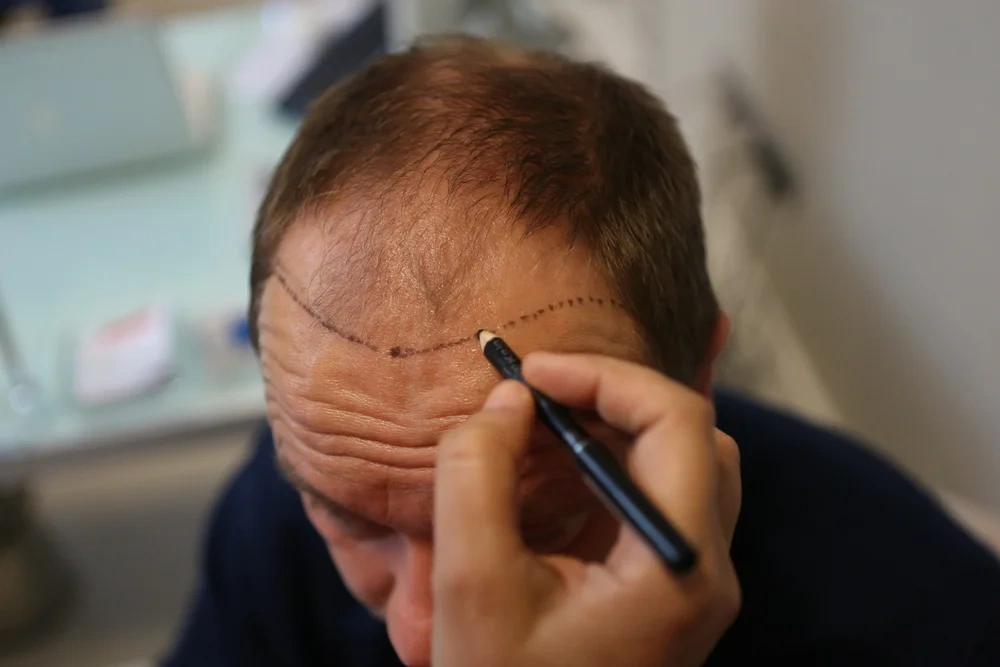
A natural hairline should complement your age, facial proportions, existing hair and expected future hair loss.
An unnaturally straight or excessively low hairline can remain noticeable even if graft survival is excellent.
2. Direction and Angle
Natural scalp hair does not grow vertically in every area.
Each graft needs to be positioned according to the natural direction and angle of surrounding hair.
This becomes especially important around the frontal hairline and temples.
3. Graft Distribution
Simply placing the maximum possible number of grafts does not necessarily produce the best result.
Available donor hair needs to be distributed strategically.
4. Donor Area Management
Your donor area is limited.
Overharvesting can negatively affect the appearance of the donor region and reduce the grafts available if future transplantation becomes necessary.
5. Graft Handling
Follicular units are delicate.
Careful extraction, storage, handling and implantation can influence graft survival and the overall result.
Which Hair Transplant Technique Is Best for Hairline Restoration?
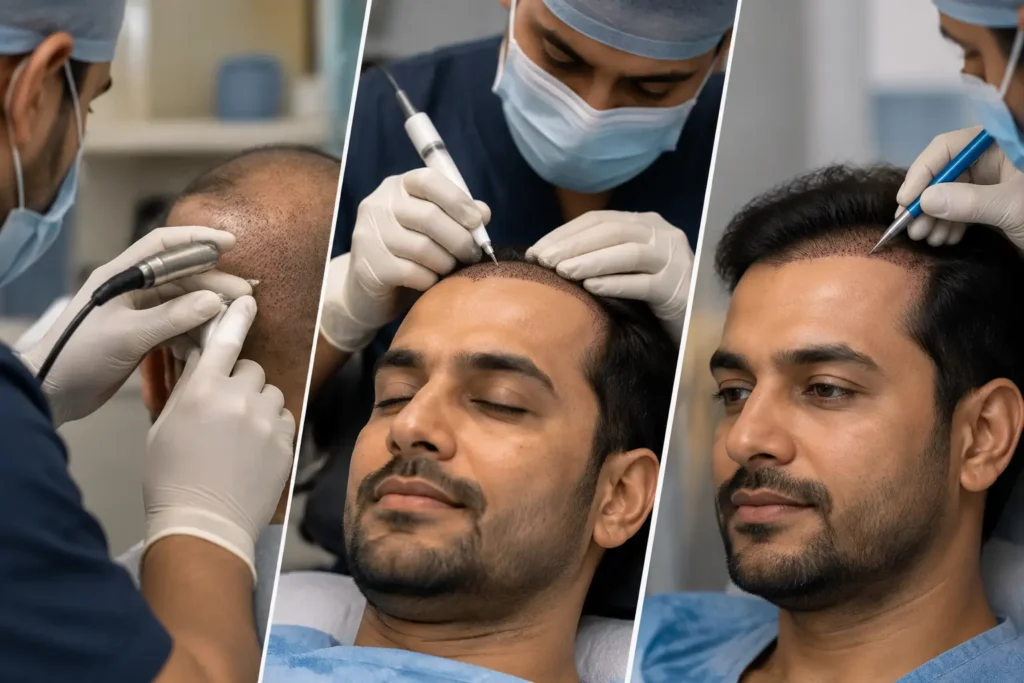
Hairline restoration requires careful attention to aesthetics.
The surgeon needs to consider:
- Facial proportions
- Existing hairline
- Degree of recession
- Age
- Hair calibre
- Hair direction
- Available donor grafts
- Expected progression of hair loss
Implanter-based placement or carefully planned recipient sites may both be used depending on the case.
The technique should support the hairline plan rather than determine it.
Which Technique Is Better for a Large Bald Area?
People with more advanced hair loss may require a larger number of grafts.
In these cases, the decision should not be based solely on choosing between FUE, DHI or Sapphire.
The surgeon needs to evaluate:
- Total safe donor capacity
- Required graft count
- Frontal versus crown priority
- Existing miniaturized hair
- Donor density
- Hair thickness
- Scalp characteristics
- Possibility of future hair loss
Trying to cover a very large bald area at maximum density may not always be realistic.
Strategic graft allocation can often be more important than the technique’s marketing name.
FUE vs DHI: Which Has Better Graft Survival?
There is no universal graft-survival percentage that can be promised for every patient.
Graft survival can be influenced by several factors, including:
- Extraction quality
- Follicle trauma
- Time outside the body
- Graft storage
- Hydration
- Implantation technique
- Recipient-site preparation
- Surgical experience
- Patient-specific factors
- Post-procedure care
Therefore, claims such as “Technique X guarantees 100% graft survival” should be approached carefully.
Hair transplantation is a medical procedure, and outcomes vary between individuals.
Does Sapphire FUE Heal Faster?
Sapphire blades are promoted for precise recipient-site creation, and emerging research has reported potentially favorable healing outcomes compared with steel blades.
However, recovery is not determined by blade material alone.
Healing can also depend on the size and number of recipient sites, surgical technique, scalp condition, procedure size and how well post-operative instructions are followed.
Patients should therefore choose their treatment based on a complete medical assessment rather than one instrument.
Is DHI More Expensive Than FUE?
Hair transplant cost varies considerably between clinics and patients.
Pricing may depend on:
- Number of grafts required
- Degree of baldness
- Technique selected
- Procedure complexity
- Donor area condition
- Number of sessions
- Surgeon and medical team
- Clinic facilities
Instead of selecting a procedure solely because it is cheaper or more expensive, understand what is included in the proposed treatment.
How Do I Know Which Hair Transplant Technique Is Right for Me?
A proper scalp and donor-area assessment is the best starting point.
During a consultation, the surgeon should evaluate your hair-loss pattern, donor density, hair calibre, scalp condition and expectations.
Your treatment plan should answer questions such as:
How many grafts are realistically required?
Is my donor area sufficient?
Which areas should be prioritized?
How will my hairline be designed?
Which extraction and implantation approach is suitable for my case?
What happens if my existing hair continues to thin in the future?
These questions are often more important than simply asking which technique is the latest.
What Should You Check Before Choosing a Hair Transplant Clinic?
Hair transplantation is a surgical procedure, so choosing the medical team deserves as much attention as choosing the technique.
Before proceeding, consider asking:
- Who will evaluate my hair loss?
- Who will design my hairline?
- Who will perform the surgical steps?
- How is my donor capacity calculated?
- How many grafts are recommended and why?
- What results are realistic for my level of hair loss?
- What are the possible risks and complications?
- What post-operative care is provided?
- What happens if my natural hair loss progresses?
Be cautious about making a decision based only on large graft-number promises, heavily edited before-and-after photographs, “scar-free” claims or guaranteed results.
FUE, DHI or Sapphire: Which One Should You Choose?
There is no universal winner.
FUE is an established approach for extracting individual follicular units and is widely used in modern hair transplantation.
DHI or implanter-based placement describes an approach to placing grafts and may be useful when controlled implantation is required.
Sapphire FUE uses sapphire blades for recipient-site creation while retaining the principles of FUE extraction.
For one patient, a particular approach may be appropriate. Another patient with a different donor area, hair-loss pattern or graft requirement may benefit from a different plan.
The objective should not be to choose the technique with the most impressive name.
The objective should be to develop a safe, individualized plan capable of producing a natural-looking and sustainable result.
Hair Transplant Consultation at Morph Aesthetic
At Morph Aesthetic, hair transplant planning begins with understanding the patient’s individual hair-loss pattern, donor area and aesthetic goals.
A personalized assessment can help determine the required grafts, appropriate hairline design and suitable transplantation approach.
If you are experiencing a receding hairline, thinning crown or progressive hair loss, schedule a consultation with Morph Aesthetic to understand the treatment options suitable for your condition.
Frequently Asked Questions
EXCELLENTTrustindex verifies that the original source of the review is Google. Good experiencePosted on GoogleTrustindex verifies that the original source of the review is Google. It is a very good clinic with a very helpful staff and extremely clean. It gives u a personalized experience and comfort like never before❣️Posted on GoogleTrustindex verifies that the original source of the review is Google. good behaviour and nice counsaltuntPosted on GoogleTrustindex verifies that the original source of the review is Google. Had a great experience with dr Ronak and dr dhaval for surgery , sakshi ma’am and dr shruti also served us meticulously.Posted on GoogleTrustindex verifies that the original source of the review is Google. Excellent service and amazing result. Highly recommend morph anesthetic. Professional staff.great care.and a wonderful experience. Best plastic surgeon in Ahmedabad.Posted on GoogleTrustindex verifies that the original source of the review is Google. Very nice service..Posted on GoogleTrustindex verifies that the original source of the review is Google. I recently had my child's surgery done at Morph Aesthetic Clinic by Dr. Dhaval Vanzara and Dr. Ronak Kadia, and I couldn't be happier. Both doctors are exceptionally skilled and professional. Before the procedure, they explained everything to me so clearly, and the final result is exactly what I expected and hoped for. Beyond their expertise, both doctors have a wonderful, kind, and supportive nature. Highly recommend this clinic for their outstanding care and perfect results.Posted on GoogleTrustindex verifies that the original source of the review is Google. Nice and clean work and dr is so humble and passionate for work and so good for attend the patient