

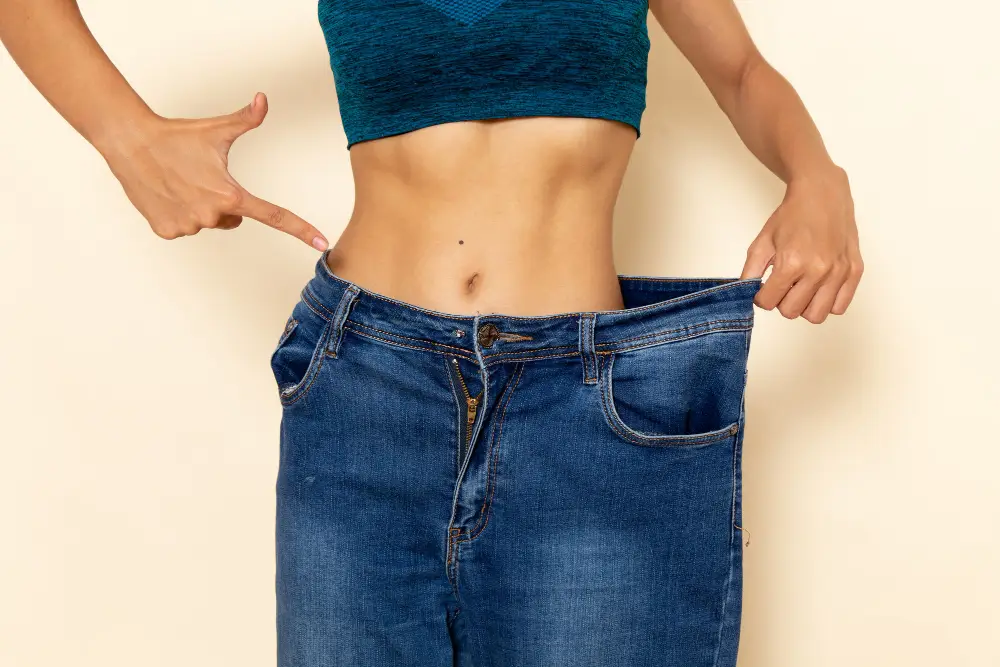
Lost Weight but Still Have Belly Fat or Loose Skin? Liposuction vs Tummy Tuck Explained
You lost the weight.
Your clothes fit better. Your waist is smaller. You may be exercising regularly and maintaining a healthier routine.
But when you look at your abdomen, something still does not match the progress you have made.
For some people, it is a small pocket of stubborn abdominal fat.
For others, it is loose or hanging skin.
And for some, there is a combination of fat, loose skin and weakness or separation of the abdominal wall.
These concerns do not all require the same treatment.
Liposuction primarily removes localised fat. A tummy tuck, or abdominoplasty, can remove excess abdominal skin and fat and can also tighten the abdominal fascia when appropriate.
Understanding that difference is essential before deciding between liposuction and tummy tuck in Ahmedabad.
Why Can Belly Fat Remain Even After Weight Loss?
Weight loss reduces overall body fat, but the body does not always lose fat evenly from every area.
Some people reach a relatively stable weight yet continue to have localised fat around areas such as the lower abdomen, waist or flanks.
This is where liposuction may have a role.
Morph Aesthetic provides liposuction and body-contouring procedures in Ahmedabad specifically for reshaping areas with localised fat deposits.
But there is an important distinction:
Liposuction is a body-contouring procedure, not a substitute for general weight loss.
It changes the contour by reducing fat cells in selected areas rather than serving as treatment for obesity. Mayo Clinic notes that the resulting contour can remain long lasting when weight remains stable.
Why Does Loose Skin Remain After Weight Loss?
Skin has elasticity, but it cannot always contract completely after a major reduction in body size.
The likelihood of loose skin can be influenced by factors such as:
- Amount of weight lost
- How long the skin was stretched
- Age
- Skin elasticity
- Pregnancy history
- Genetics
- Previous abdominal changes
The American Society of Plastic Surgeons explains that after substantial weight loss, skin and supporting tissues may lack enough elasticity to fully conform to the smaller body size.
This creates a crucial treatment difference.
Fat can be removed with liposuction.
Significant excess skin usually needs a procedure designed to remove or tighten skin.
Removing more fat does not automatically make loose skin disappear.
Liposuction vs Tummy Tuck: The Simple Difference
Before going deeper, this is the easiest way to understand the two procedures.
Liposuction
Best suited primarily to:
Localised fat + relatively good skin elasticity
Tummy Tuck
More relevant when there is:
Loose abdominal skin ± excess fat ± abdominal wall laxity
Combination Treatment
May be considered when someone has:
Stubborn fat + significant loose skin
Mayo Clinic notes that liposuction is often performed as part of a tummy tuck when additional contouring of the abdomen is useful.
So this should not always be viewed as:
Liposuction OR tummy tuck.
For some patients, the appropriate answer can be both, although that decision requires individual surgical assessment.
What Exactly Does Liposuction Do?
Liposuction removes fat from selected areas using a thin instrument called a cannula.
The objective is to reshape or contour an area rather than produce major overall weight reduction.
Common treatment areas can include the abdomen, flanks, thighs and other localised fat deposits. Morph Aesthetic currently offers liposuction and body-contouring treatment in Ahmedabad.
For someone who has already lost weight, liposuction may be relevant when:
- Weight is relatively stable
- A localised abdominal bulge remains
- Skin still has reasonably good elasticity
- There is no major hanging skin
- The main problem is fat rather than skin
The skin then needs to adapt to the new contour after fat removal.
And that is where skin quality becomes extremely important.
Liposuction Does Not Tighten Significant Loose Skin
This is one of the biggest misconceptions around body contouring.
Someone may think:
“If the surgeon removes all this fat, the loose skin will become tight automatically.”
That is not guaranteed.
Mayo Clinic specifically notes that skin generally conforms better after liposuction when it has good tone and elasticity. When skin is thin or lacks elasticity, it may remain loose after fat removal.
The American Society of Plastic Surgeons similarly explains that removing fat without accounting for poor skin elasticity can leave looseness or make it more noticeable.
This means that more aggressive liposuction is not always better.
If the main concern is loose skin, simply removing additional fat can potentially produce a worse contour rather than a tighter abdomen.
What Does a Tummy Tuck Do?
A tummy tuck, medically called abdominoplasty, addresses abdominal skin and deeper support structures differently.
During a tummy tuck, excess skin and fat can be removed, and the abdominal fascia may be tightened. When abdominal muscles have separated, the procedure can also bring the muscle contours together.
A tummy tuck may therefore address problems that liposuction alone cannot:
- Hanging abdominal skin
- Significant lower-abdominal skin laxity
- Stretched abdominal tissues
- Abdominal bulging related to rectus diastasis
- Combination of excess skin and fat
Morph Aesthetic currently provides tummy-tuck surgery in Ahmedabad as part of its body-contouring services.
What Is Rectus Diastasis?
Some people have a protruding abdomen even when there is not a large amount of fat.
One possible reason is rectus diastasis, where the abdominal muscles have separated and the supporting tissue between them has stretched.
This is particularly associated with pregnancy but can occur in other circumstances as well.
Mayo Clinic notes that a tummy tuck can repair rectus diastasis by tightening the abdominal fascia and bringing separated muscle contours together.
Liposuction does not repair muscle separation.
So if the primary problem is:
muscle separation + loose skin
rather than:
a localised fat pocket
liposuction alone may not create the desired result.
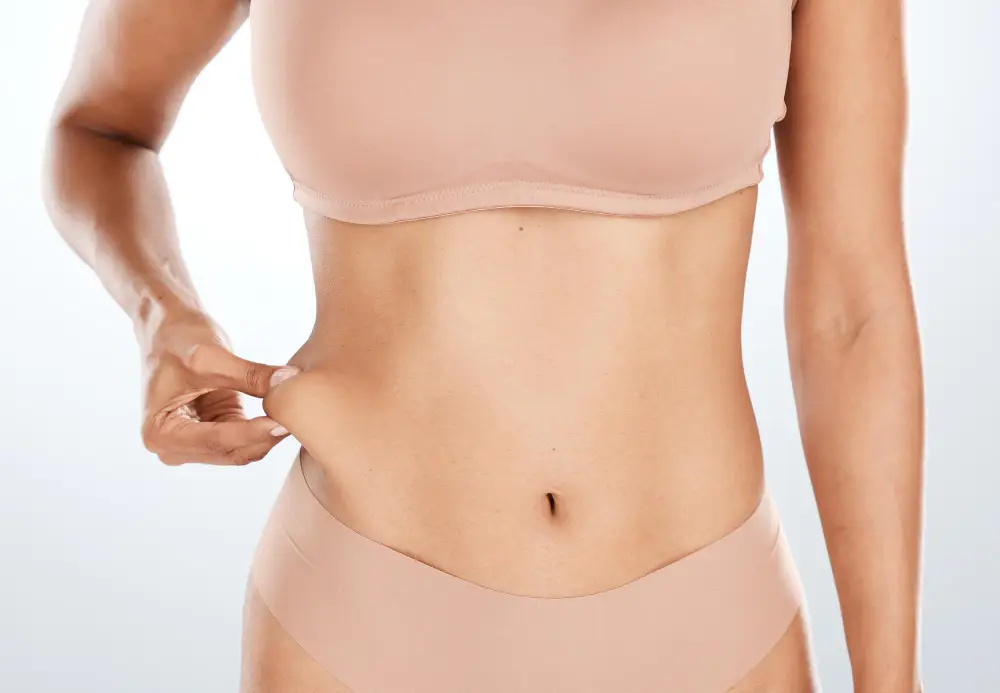
How Can You Tell Whether You Have Fat or Loose Skin?
You cannot determine candidacy perfectly at home, but the appearance can provide clues.
More likely to be primarily fat
The abdominal tissue feels relatively thick and full.
The skin still appears reasonably firm.
There is no major fold or hanging skin.
Your weight is stable, but a localised bulge remains.
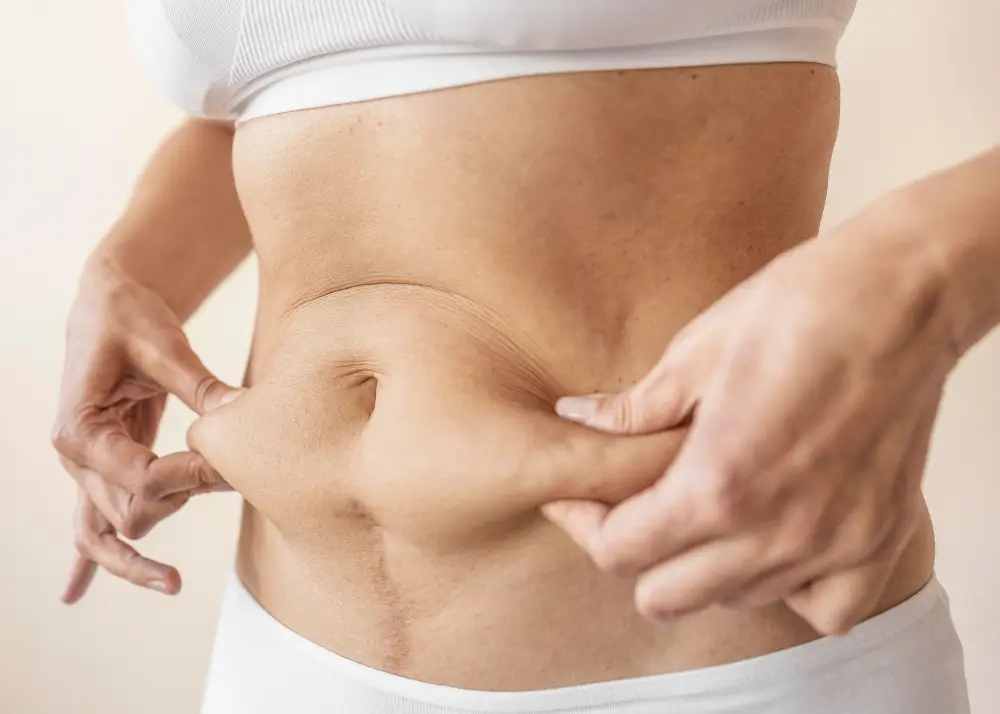
More likely to involve significant loose skin
The skin looks wrinkled, folded or empty.
Skin hangs when standing or bending.
There has been substantial weight loss.
The abdomen looks deflated rather than simply thick.
Stretching or pregnancy has significantly affected the skin.
More likely to involve both
There is still a noticeable fat layer underneath loose, hanging skin.
This mixed presentation is common after substantial body changes.
A plastic surgeon needs to evaluate fat thickness, skin elasticity, abdominal wall strength and overall body proportions rather than choosing the operation based only on photographs.
“I Can Pinch My Belly. Does That Mean It Is Fat?”
Not necessarily.
When you pinch the abdomen, you are usually holding a combination of skin and underlying subcutaneous tissue.
So the popular self-test:
“If I can pinch it, it’s fat.”
is not reliable enough to decide between liposuction and a tummy tuck.
The clinically relevant questions are:
- How much fat is present?
- How much excess skin is present?
- Will the skin contract after fat removal?
- Is there muscle separation?
- Where is the excess tissue located?
That is why two people who appear to have similar lower-belly concerns in photographs may receive completely different recommendations.
Who May Be Better Suited to Liposuction?
Liposuction may be considered when someone:
- Is relatively close to a stable weight
- Has localised fat that persists despite overall weight reduction
- Has reasonably firm and elastic skin
- Does not have a large amount of excess hanging skin
- Is medically suitable for elective surgery
- Has realistic expectations about body contouring
Mayo Clinic notes that liposuction candidates need to be in sufficiently good health for surgery and that skin quality influences how smoothly the skin adapts afterward.
A person who expects liposuction to remove 20 kilograms or completely tighten severely loose skin is starting with the wrong expectation.
Who May Be Better Suited to a Tummy Tuck?
A tummy tuck becomes more relevant when the main problems include:
- Significant loose abdominal skin
- Hanging lower-abdominal tissue
- Major skin laxity after weight loss
- Changes following pregnancy
- Abdominal muscle separation
- Combination of skin and localised fat
According to Mayo Clinic, common reasons for considering a tummy tuck include major weight changes, pregnancy, previous abdominal surgery, ageing and natural body type.
ASPS similarly identifies tummy tuck as one of the body-contouring procedures used to address excess abdominal skin after substantial weight loss.
When Might You Need Both Liposuction and a Tummy Tuck?
This is common enough that it deserves its own explanation.
Imagine someone has:
Loose lower-abdominal skin + fat around the waist and flanks.
A tummy tuck can address the excess skin and abdominal wall.
Liposuction may then be used strategically to improve the surrounding contour.
Mayo Clinic notes that liposuction is often combined with tummy tuck to contour the abdominal region.
Modern body-contouring planning also considers how much the skin can retract after fat removal. In patients with poor elasticity, ASPS notes that liposuction may need to be combined with a tightening or lifting procedure.
The goal should therefore be a balanced contour, not simply maximum fat removal.
Can Exercise Tighten Loose Skin After Major Weight Loss?
Exercise is extremely useful for maintaining weight, improving fitness and developing the underlying muscles.
But exercise cannot physically remove a substantial fold of excess skin.
The American Society of Plastic Surgeons describes surgical body contouring as removing excess sagging skin and fat when tissue does not conform adequately after major weight loss.
Building abdominal muscle may improve the underlying shape, but if the visible problem is significant redundant skin, doing hundreds of additional crunches will not excise that skin.
That distinction matters because some patients spend years assuming they simply have not exercised hard enough.
Can Liposuction Remove Loose Skin?
No, not in the same way a tummy tuck can.
Liposuction removes subcutaneous fat.
If your skin is elastic, it may retract to some degree after the underlying fat volume decreases.
But if significant laxity is already present, the skin may remain loose. Mayo Clinic explicitly identifies limited skin elasticity as a factor that can leave treated areas looking loose after liposuction.
So the correct question is not:
“Can liposuction make my abdomen smaller?”
It is:
“Will my skin adapt well enough after the fat is removed?”
Does a Tummy Tuck Remove Fat Too?
Yes, some abdominal fat can be removed as part of the tissue excision during a tummy tuck, and liposuction may be added for additional contouring.
However, the central value of a tummy tuck is not simply fat removal.
It can address:
skin + connective tissue + abdominal contour
in a way that liposuction alone cannot.
This is why calling tummy tuck “a bigger liposuction” is inaccurate.
They are fundamentally different operations.
Can a Tummy Tuck Remove Stretch Marks?
A tummy tuck is not specifically a stretch-mark treatment.
However, stretch marks located on skin that is surgically removed, particularly excess lower-abdominal skin, may also be removed with that tissue.
Mayo Clinic notes that a tummy tuck may remove some stretch marks in the lower abdomen below the belly button when that skin is excised.
Stretch marks outside the removed skin remain.
So patients should not expect abdominoplasty to erase every stretch mark across the abdomen.
Does Liposuction Remove Cellulite or Stretch Marks?
No.
Mayo Clinic specifically states that liposuction does not correct cellulite and does not remove stretch marks.
The purpose is contouring by reducing localised fat.
This is another reason treatment goals need to be defined clearly during consultation.
Should You Get Surgery Immediately After Losing Weight?
Usually, stable weight is preferable before major body-contouring surgery.
If someone continues losing a substantial amount of weight after surgery, new skin laxity and contour changes can develop.
Mayo Clinic advises maintaining a stable weight before tummy tuck and notes that significant weight loss afterward can alter the result.
So if you still intend to lose a large amount of weight, the better plan may be:
Complete the weight-loss phase → maintain a stable weight → reassess the remaining skin and fat → then discuss body contouring.
Aesthetic surgery should refine the result of weight loss, not interrupt an unfinished weight-loss journey.
What If You Plan to Become Pregnant?
Pregnancy can significantly stretch abdominal skin and muscles again.
For that reason, someone considering pregnancy in the relatively near future may be advised to postpone a tummy tuck.
Mayo Clinic specifically lists future pregnancy plans among situations where a surgeon may advise against proceeding with abdominoplasty at that time.
This does not mean a woman who has had a tummy tuck can never become pregnant.
It means pregnancy can alter the surgical result, so timing matters.
Liposuction Recovery vs Tummy Tuck Recovery
A tummy tuck is generally a more extensive operation than isolated liposuction because it involves skin removal and potentially abdominal-wall tightening.
Mayo Clinic notes that tummy-tuck patients may require drains, an abdominal support garment, activity restrictions and several weeks before returning to normal work depending on the physical demands of the job.
Liposuction also causes postoperative swelling and carries surgical risks, but the recovery profile differs according to:
- Treatment area
- Amount of fat removed
- Number of areas
- Technique
- Whether other surgery is combined
- Individual healing
Recovery time should therefore come from the operating surgeon after the exact procedure has been planned.
Will a Tummy Tuck Leave a Scar?
Yes.
This needs to be stated clearly.
Abdominoplasty removes excess tissue through an incision, so a permanent scar is part of the trade-off.
Mayo Clinic notes that the tummy-tuck incision scar is permanent, though surgeons generally position it low enough to be concealed by many types of underwear or swimwear. Its length varies according to the amount of skin being removed.
Anyone promising a “scarless tummy tuck” should immediately make you sceptical.
The realistic discussion is about scar placement, length and maturation, not pretending there will be no incision.
Is Liposuction Scarless?
Not completely.
Liposuction uses much smaller access incisions than a tummy tuck, but small scars can still occur where the cannula enters.
So “minimal scar” can be reasonable language depending on technique.
“Absolutely no scar” is not.
Every surgical incision has the potential to leave a mark.
What Are the Risks of Liposuction?
Liposuction is surgery, not a beauty treatment without medical risk.
Potential complications include contour irregularities, fluid collections, altered sensation, infection and, more rarely, serious complications such as fat embolism or problems related to major fluid shifts.
Risk depends on factors including:
- Amount treated
- Areas treated
- Patient health
- Surgical technique
- Whether procedures are combined
Proper patient selection and qualified surgical care matter.
What Are the Risks of a Tummy Tuck?
Abdominoplasty also carries meaningful surgical risks.
Mayo Clinic lists complications including:
- Seroma or fluid collection
- Poor wound healing
- Infection
- Permanent scarring
- Changes in skin sensation
- Tissue damage
- Bleeding
- Anaesthesia-related complications
Smoking can impair skin blood flow and wound healing, which is one reason surgeons may require patients to stop smoking before and during recovery.
This is elective surgery, so the benefits should always be weighed against these risks.
Liposuction vs Tummy Tuck: Which Gives the Flatter Abdomen?
Neither procedure automatically gives a “better” result.
The better procedure is the one that matches the actual anatomy.
Situation 1
Small stubborn fat pocket + tight skin
Likely discussion: Liposuction
Situation 2
Very little excess fat + significant hanging skin
Likely discussion: Tummy tuck
Situation 3
Loose skin + muscle separation
Likely discussion: Tummy tuck with abdominal-wall repair where appropriate
Situation 4
Loose skin + stubborn abdominal and flank fat
Possible discussion: Tummy tuck + liposuction
Situation 5
Still significantly above goal weight and actively losing
Often: Continue weight management before deciding on contouring surgery
The mistake is choosing the operation based on which procedure is more popular rather than what problem actually needs correction.
Can Liposuction Make Loose Skin Look Worse?
It can in some patients.
If skin has poor elasticity and a significant amount of underlying fat is removed, the loss of volume can reveal or accentuate pre-existing laxity.
ASPS specifically warns that excessive fat removal in areas with weak skin support can lead to more visible sagging or irregularity.
This is why a responsible surgeon may sometimes tell a patient:
“Liposuction alone is not the right procedure for you.”
That is not upselling.
In the right case, it is avoiding the wrong operation.
What About Loose Skin After Major Weight Loss?
Major weight loss can affect more than the abdomen.
Loose skin can also occur around the:
- Arms
- Thighs
- Breasts
- Buttocks
- Lower body
ASPS describes post-weight-loss body contouring as a group of procedures designed to remove excess sagging skin and improve the underlying body contour.
So a tummy tuck may address the abdomen, but someone after very large weight loss may need a broader body-contouring assessment rather than treating every area with liposuction.
Why Stable Weight Matters for Long-Term Results
Neither liposuction nor tummy tuck prevents future weight gain.
After liposuction, remaining fat cells can still enlarge if significant weight is gained. Mayo Clinic notes that liposuction contour changes are generally long lasting when body weight remains stable.
Tummy-tuck results are also generally longer lasting when weight remains stable.
The procedures therefore work best when surgery is followed by realistic long-term weight maintenance.
They are contouring tools, not replacements for nutrition, physical activity or metabolic health management.
Questions to Ask Before Choosing Liposuction or Tummy Tuck
During consultation, don’t simply ask:
“Which one is cheaper?”
Ask:
- Is my main problem fat, skin or both?
- How good is my skin elasticity?
- Do I have abdominal muscle separation?
- Would liposuction worsen my loose skin?
- Do I need a full tummy tuck or another approach?
- Would combining liposuction and tummy tuck be appropriate?
- Where will the scars be?
- What recovery should I realistically expect?
- What surgical risks apply specifically to me?
- Should I lose or maintain more weight before surgery?
Those answers matter more than procedure names.
Liposuction and Tummy Tuck in Ahmedabad at Morph Aesthetic
Morph Aesthetic in Ahmedabad provides both liposuction/body contouring and tummy-tuck surgery, allowing the treatment plan to be based on whether the primary concern is localised fat, excess abdominal skin or a combination.
For a patient who has already lost weight, the consultation should specifically assess:
remaining fat + amount of loose skin + skin elasticity + abdominal wall + weight stability + future goals.
That is much more useful than deciding beforehand:
“I want liposuction because I don’t want a tummy tuck.”
or
“I need a tummy tuck because my stomach is not flat.”
Sometimes the anatomy says otherwise.
The Bottom Line: Fat and Loose Skin Are Different Problems
Losing weight and still being unhappy with the abdominal contour does not mean the weight loss “didn’t work.”
It often means weight loss has already done its job, but the remaining concern is now structural.
The practical distinction is:
Stubborn localised fat + good skin → liposuction may be appropriate
Significant loose skin → tummy tuck may be more appropriate
Loose skin + muscle separation → tummy tuck can address both where suitable
Fat + loose skin → combination treatment may sometimes produce a better contour
Modern body contouring works best when the surgeon treats the actual tissue problem rather than simply removing as much fat as possible.
For patients considering liposuction or tummy tuck in Ahmedabad, Morph Aesthetic offers both procedures and individual body-contouring assessment.
FAQs
EXCELLENTTrustindex verifies that the original source of the review is Google. Good experiencePosted on GoogleTrustindex verifies that the original source of the review is Google. It is a very good clinic with a very helpful staff and extremely clean. It gives u a personalized experience and comfort like never before❣️Posted on GoogleTrustindex verifies that the original source of the review is Google. good behaviour and nice counsaltuntPosted on GoogleTrustindex verifies that the original source of the review is Google. Had a great experience with dr Ronak and dr dhaval for surgery , sakshi ma’am and dr shruti also served us meticulously.Posted on GoogleTrustindex verifies that the original source of the review is Google. Excellent service and amazing result. Highly recommend morph anesthetic. Professional staff.great care.and a wonderful experience. Best plastic surgeon in Ahmedabad.Posted on GoogleTrustindex verifies that the original source of the review is Google. Very nice service..Posted on GoogleTrustindex verifies that the original source of the review is Google. I recently had my child's surgery done at Morph Aesthetic Clinic by Dr. Dhaval Vanzara and Dr. Ronak Kadia, and I couldn't be happier. Both doctors are exceptionally skilled and professional. Before the procedure, they explained everything to me so clearly, and the final result is exactly what I expected and hoped for. Beyond their expertise, both doctors have a wonderful, kind, and supportive nature. Highly recommend this clinic for their outstanding care and perfect results.Posted on GoogleTrustindex verifies that the original source of the review is Google. Nice and clean work and dr is so humble and passionate for work and so good for attend the patient