

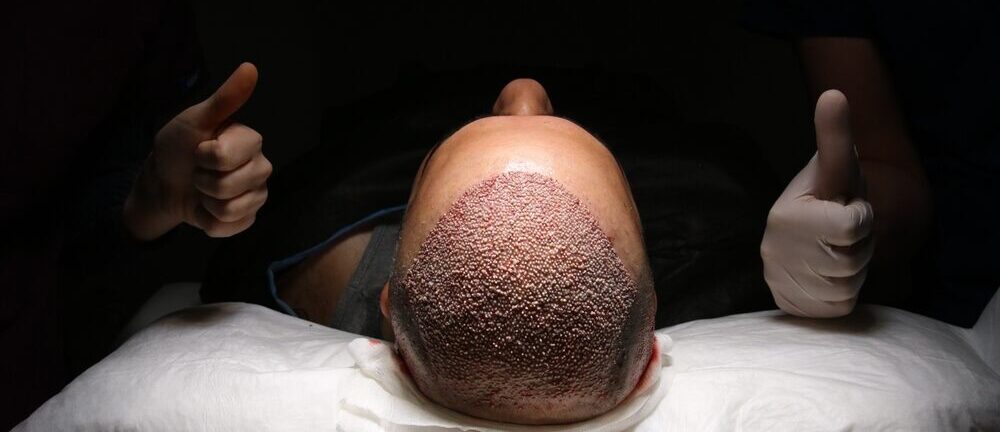
How Many Grafts Do You Need for a Hair Transplant? A Complete Guide by Baldness Level
One of the first questions people ask when considering a hair transplant is:
“How many grafts will I need?”
You may see estimates such as 1,500 grafts for a receding hairline, 3,000 grafts for more extensive hair loss or 4,000+ grafts for advanced baldness.
But there is no single graft number that works for everyone.
The number of hair grafts required depends on the size of the bald or thinning area, donor hair availability, desired density, hair characteristics, age and expected progression of hair loss.
Understanding how graft requirements are estimated can help you have a more informed conversation before undergoing a hair transplant.
What Is a Hair Graft?
A hair graft is a naturally occurring follicular unit that is extracted from the donor area and transplanted into the recipient area.
One graft does not necessarily mean one hair.
A follicular unit may contain:
- One hair
- Two hairs
- Three hairs
- Occasionally four or more hairs
This distinction is important.
For example, 2,000 grafts does not necessarily mean 2,000 individual hairs. The actual number of hairs transplanted can be considerably higher depending on the composition of the follicular units.
Why Does Graft Count Matter?
Your available donor hair is limited.
Hair used for transplantation is usually harvested from appropriate areas at the back and sides of the scalp.
Once grafts are removed and transplanted, they cannot simply be replaced in the donor area.
This means hair transplant planning is not about extracting the maximum possible number of grafts.
The objective is to use the available donor supply strategically to create natural-looking coverage while preserving sufficient donor hair whenever possible.
This becomes particularly important in younger patients whose hair loss may continue to progress.
What Is the Norwood Scale?
The Norwood-Hamilton Scale is commonly used to describe different stages of male pattern hair loss.
It ranges from relatively mild recession to advanced hair loss.
In simplified terms:
Norwood 1: Little or no significant recession
Norwood 2: Mild recession around the temples
Norwood 3: More noticeable recession or frontal hair loss
Norwood 4: Greater frontal loss, often with crown involvement
Norwood 5: Larger areas of frontal, mid-scalp and crown loss
Norwood 6: Frontal and crown areas become more extensively connected
Norwood 7: Advanced hair loss with a limited remaining horseshoe-shaped donor region
The Norwood stage can help estimate the size of the area requiring restoration, but it cannot determine the exact graft count on its own.
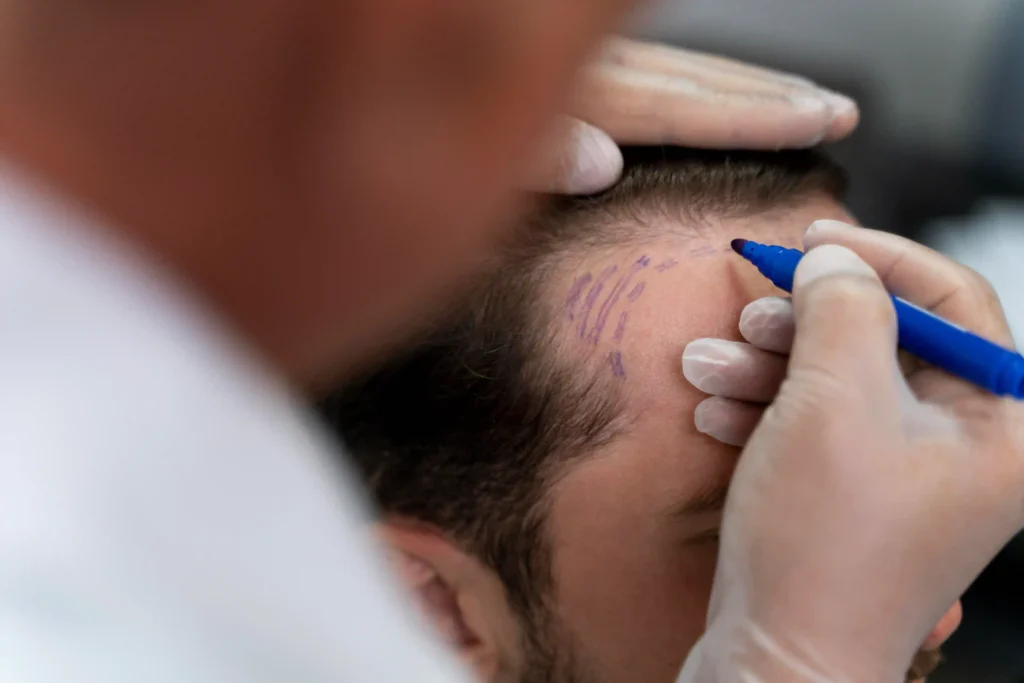
Hair Transplant Grafts by Norwood Scale
The following figures should be treated as broad educational estimates rather than guaranteed requirements.
Actual graft numbers can differ substantially between patients.
Norwood 2: Approximately 800–1,500 Grafts
Norwood 2 generally involves mild recession at the temples or early changes to the frontal hairline.
Treatment may focus on:
- Filling the temple recession
- Strengthening the frontal hairline
- Improving symmetry
- Creating an age-appropriate hairline
Because the recipient area is relatively small, fewer grafts may be required compared with advanced hair loss.
However, creating an excessively low hairline simply because more donor hair is available is not always appropriate.
Long-term planning is especially important in younger patients.
Norwood 3: Approximately 1,500–2,500 Grafts
Norwood 3 typically involves deeper recession and more obvious frontal hair loss.
The treatment area may include:
- Frontal hairline
- Temples
- Frontal scalp
- Early crown involvement in some patterns
The exact requirement depends heavily on the width of the forehead, desired hairline position and existing hair density.
Someone requiring only frontal restoration may need significantly fewer grafts than another patient with both frontal and crown thinning.
Norwood 4: Approximately 2,500–3,500 Grafts
At Norwood 4, hair loss is generally more extensive.
Patients may have:
- Significant frontal recession
- Mid-scalp thinning
- A developing or established crown area
- A band of existing hair separating the frontal and crown regions
The surgeon may need to decide how the available grafts should be distributed.
In some patients, greater density may be prioritized in the frontal region because it has a stronger visual impact.
The crown can then be treated according to donor availability and individual goals.
Norwood 5: Approximately 3,500–4,500+ Grafts
Norwood 5 represents more advanced hair loss.
The frontal and crown areas become larger, and the band separating them becomes narrower.
Restoring every area at high density may not always be realistic.
Planning can involve prioritizing:
- Hairline
- Frontal scalp
- Mid-scalp
- Crown
Patients with strong donor density and favourable hair characteristics may achieve broader coverage, while others may need a more conservative approach.
Multiple sessions may also be considered in selected cases.
Norwood 6: Approximately 4,000–5,500+ Grafts
Norwood 6 involves extensive hair loss across the front, mid-scalp and crown.
At this stage, donor management becomes particularly important.
The area requiring coverage can be much larger than the amount of donor hair available to recreate original density.
Therefore, the objective may shift from recreating a full head of youthful-density hair to creating the visual impression of coverage through strategic graft placement.
Some patients may require more than one session.
The frontal region is often prioritized because it frames the face and usually provides greater cosmetic impact.
Norwood 7: Highly Individualized
Norwood 7 represents the most advanced stage of male pattern hair loss.
The donor area may be relatively limited compared with the large recipient area.
This means not every Norwood 7 patient will be an ideal candidate for extensive hair transplantation.
Treatment planning may require:
- Conservative hairline design
- Frontal-area prioritization
- Lower overall recipient density
- Multiple sessions
- Careful donor preservation
In selected cases, alternative donor sources may be considered by an experienced surgeon, but suitability varies considerably.
For advanced baldness, promising a specific large graft count before evaluating the donor area should be approached cautiously.
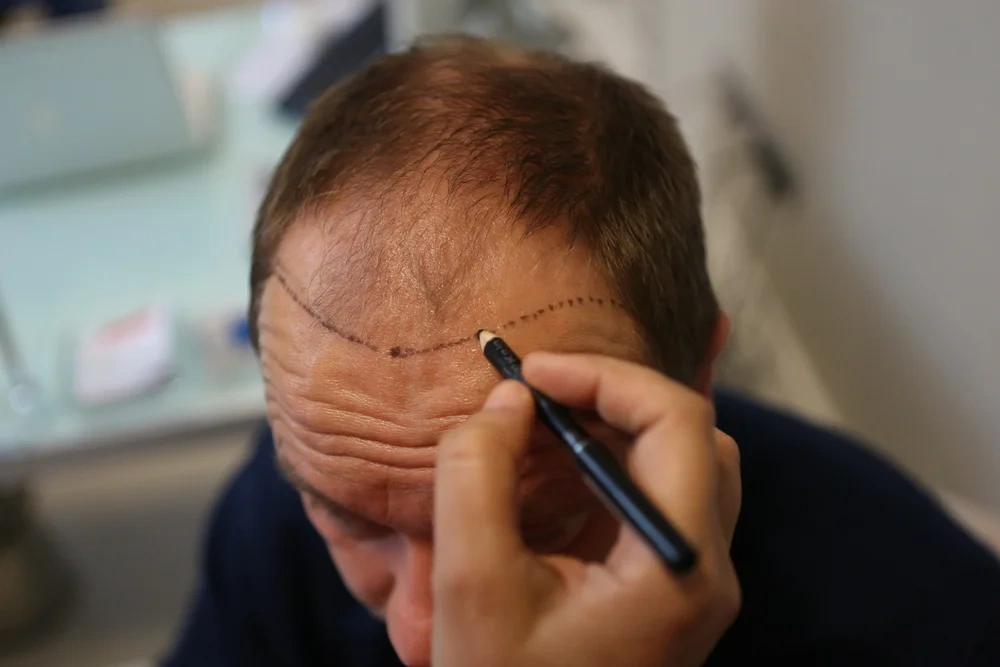
Quick Hair Transplant Graft Estimate
Baldness Level | Approximate Graft Range* |
Norwood 2 | 800–1,500 |
Norwood 3 | 1,500–2,500 |
Norwood 4 | 2,500–3,500 |
Norwood 5 | 3,500–4,500+ |
Norwood 6 | 4,000–5,500+ |
Norwood 7 | Individual assessment required |
*These are broad educational ranges only. Your actual requirement can be lower or higher depending on recipient area, donor capacity, hair characteristics and treatment goals.
How Many Grafts Are Needed for the Hairline?
Hairline restoration does not depend simply on filling an empty area with as many grafts as possible.
The surgeon needs to consider:
- Width of the frontal area
- Depth of recession
- Existing hair
- Facial proportions
- Hairline position
- Desired density
- Hair calibre
- Available donor supply
Single-hair follicular units are often particularly useful around the leading edge of a hairline to help create a softer, more natural transition.
Multi-hair grafts can then contribute to density behind the hairline where appropriate.
The exact graft count should therefore be based on the entire design rather than a standard “hairline package.”
How Many Grafts Are Needed for the Crown?
The crown can require a surprisingly large number of grafts.
Unlike the frontal hairline, crown hair grows in a circular or whorl pattern.
The area can also expand as male pattern hair loss progresses.
Depending on the size of the crown, hundreds to several thousand grafts may potentially be required.
This creates an important planning decision.
If donor supply is limited and both the front and crown require treatment, using too many grafts in the crown may reduce the number available for the frontal and mid-scalp areas.
The appropriate priority depends on the patient’s hair-loss pattern and goals.
Is 2,000 Grafts Enough for a Hair Transplant?
For some patients, yes.
Approximately 2,000 grafts may provide meaningful restoration for someone with moderate frontal recession or a relatively limited treatment area.
For someone with extensive frontal, mid-scalp and crown baldness, 2,000 grafts would usually need to be distributed much more selectively.
Therefore, asking whether 2,000 grafts is “enough” without knowing the size of the recipient area does not provide a meaningful answer.
Is 3,000 Grafts a Lot?
Three thousand grafts represents a substantial hair transplant procedure, but whether it is a lot depends on the patient’s condition.
For one person, 3,000 grafts may be enough to restore the frontal and mid-scalp areas.
For another with advanced hair loss, the same number may only provide strategic coverage of selected areas.
The number of grafts should always be considered relative to the area being treated.
Are 4,000 or 5,000 Grafts Safe?
A higher graft count does not automatically mean a better hair transplant.
The number that can be safely harvested depends on factors such as:
- Donor density
- Size of the safe donor area
- Hair calibre
- Follicular-unit distribution
- Previous hair transplant procedures
- Extraction pattern
- Expected future hair loss
Aggressively extracting grafts simply to achieve a high number can risk an overharvested or visibly depleted donor area.
The safe number must therefore be determined individually.
What Determines How Many Hair Grafts You Need?
Several factors influence your actual graft requirement.
1. Size of the Bald Area
A larger recipient area generally requires more grafts to create comparable coverage.
2. Existing Hair Density
Someone with thinning hair may require grafts between existing follicles rather than complete reconstruction of a bald area.
3. Donor Hair Density
Patients with naturally dense donor areas may have greater harvesting potential than patients with lower donor density.
4. Hair Thickness
Thicker hair shafts can create more visual coverage than very fine hair.
This means two people receiving the same number of grafts may achieve different visual density.
5. Hair Characteristics
Straight, wavy or curly hair can produce different coverage effects.
Hair-to-scalp colour contrast can also influence the appearance of density.
6. Desired Hairline
A lower hairline creates a larger treatment area and therefore usually requires more grafts.
An age-appropriate, conservative hairline can help use the donor supply more efficiently.
7. Crown Treatment
Adding crown restoration can substantially increase the overall graft requirement.
8. Future Hair Loss
Male pattern hair loss is progressive.
A treatment plan should consider what the patient’s scalp could look like several years after the procedure, not only how it looks today.
Why More Grafts Do Not Always Mean Better Results
It is easy to assume:
More grafts = more density = better hair transplant.
But that is an oversimplification.
An excellent result depends on several factors:
- Natural hairline design
- Correct graft angle
- Appropriate direction
- Strategic density
- Careful graft handling
- Donor preservation
- Recipient-site planning
- Long-term hair-loss management
Using 4,000 grafts poorly can produce a less natural result than using 2,500 grafts strategically.
The goal should be effective use of available donor hair, not simply achieving the highest graft number.
Can Too Many Grafts Be Extracted?
Yes.
Overharvesting is an important concern in hair transplantation.
If too many follicular units are removed from a limited donor area, the back or sides of the scalp can begin to look visibly thin or patchy.
This is particularly relevant with FUE because individual grafts are extracted across the donor region.
A properly planned extraction pattern should consider both the current procedure and the patient’s possible future needs.
Your Donor Area Is a Limited Resource
Think of donor hair as a lifetime supply.
Once a follicular unit is moved from the donor area to the recipient area, it is no longer available for another location.
This matters because male pattern hair loss may continue after a transplant.
For example, a younger patient may restore the frontal hairline today but experience additional mid-scalp or crown loss several years later.
If too much donor hair was used during the first procedure, options for future restoration may become limited.
Conservative donor management is therefore an important part of long-term hair transplant planning.
How Is the Exact Graft Count Calculated?
A proper consultation can include assessment of:
Recipient area:
How much scalp requires transplantation?
Donor density:
How many suitable follicular units are available?
Hair characteristics:
Is the hair fine, medium or thick?
Follicular-unit composition:
How many single-, double- and multi-hair grafts are present?
Target density:
What level of visual coverage is realistic?
Future hair-loss pattern:
How much donor supply should potentially be preserved?
The surgeon can combine these factors to estimate an appropriate graft range.
Can You Calculate Hair Grafts From a Photo?
Photographs can help with an initial assessment, particularly when showing the front, temples, top, crown and donor area.
However, photographs cannot always accurately measure:
- Donor density
- Hair calibre
- Miniaturization
- Scalp characteristics
- Safe donor boundaries
- Follicular-unit composition
An in-person scalp and donor examination can therefore provide a more reliable treatment plan.
What Should You Ask During Your Hair Transplant Consultation?
Instead of only asking “How many grafts do I need?”, ask:
Why do I need this number of grafts?
Which areas will receive those grafts?
What density are you planning?
How strong is my donor area?
How many grafts should remain available for the future?
Will my crown be treated during the same procedure?
What happens if my natural hair continues to thin?
These questions provide much more useful information than comparing clinics solely by the number of grafts they offer.
Hair Transplant Graft Assessment at Morph Aesthetic
At Morph Aesthetic, hair transplant planning should begin with evaluating the complete picture rather than choosing an arbitrary graft number.
The assessment considers the patient’s hair-loss pattern, donor area, recipient area, hair characteristics, desired hairline and long-term restoration goals.
Whether you need hairline restoration, frontal coverage, crown restoration or treatment for more advanced hair loss, an individualized assessment can help determine a realistic graft requirement.
If you are considering a hair transplant in Ahmedabad, schedule a consultation with Morph Aesthetic to understand your donor capacity, expected graft requirement and suitable treatment approach.
EXCELLENTTrustindex verifies that the original source of the review is Google. Good experiencePosted on GoogleTrustindex verifies that the original source of the review is Google. It is a very good clinic with a very helpful staff and extremely clean. It gives u a personalized experience and comfort like never before❣️Posted on GoogleTrustindex verifies that the original source of the review is Google. good behaviour and nice counsaltuntPosted on GoogleTrustindex verifies that the original source of the review is Google. Had a great experience with dr Ronak and dr dhaval for surgery , sakshi ma’am and dr shruti also served us meticulously.Posted on GoogleTrustindex verifies that the original source of the review is Google. Excellent service and amazing result. Highly recommend morph anesthetic. Professional staff.great care.and a wonderful experience. Best plastic surgeon in Ahmedabad.Posted on GoogleTrustindex verifies that the original source of the review is Google. Very nice service..Posted on GoogleTrustindex verifies that the original source of the review is Google. I recently had my child's surgery done at Morph Aesthetic Clinic by Dr. Dhaval Vanzara and Dr. Ronak Kadia, and I couldn't be happier. Both doctors are exceptionally skilled and professional. Before the procedure, they explained everything to me so clearly, and the final result is exactly what I expected and hoped for. Beyond their expertise, both doctors have a wonderful, kind, and supportive nature. Highly recommend this clinic for their outstanding care and perfect results.Posted on GoogleTrustindex verifies that the original source of the review is Google. Nice and clean work and dr is so humble and passionate for work and so good for attend the patient