


Gynecomastia Surgery Recovery: When Can You Return to Work, Gym and Normal Life?
If you are planning gynecomastia surgery, one of your biggest concerns may not be the procedure itself but what happens afterward.
How long does gynecomastia surgery recovery take?
When can you go back to work?
When can you start driving?
And most importantly for many patients, when can you return to the gym?
Recovery after gynecomastia surgery varies from person to person. The timeline depends on the amount of gland and fat removed, whether liposuction or gland excision is performed, whether excess skin needs to be removed, your healing response and the surgeon’s postoperative protocol.
This guide explains what you may generally expect during gynecomastia surgery recovery and why following your surgeon’s individual instructions matters.
What Happens Immediately After Gynecomastia Surgery?
After male breast reduction surgery, dressings are generally applied over the treated area.
A compression garment may also be recommended to support the chest and help manage postoperative swelling.
Depending on the procedure, a surgeon may temporarily place drains to remove excess fluid or blood.
During the first few days, it is normal to experience some:
- Swelling
- Bruising
- Tightness
- Tenderness
- Temporary numbness
- Mild to moderate discomfort
These symptoms generally improve as healing progresses.
Gynecomastia Surgery Recovery Timeline
There is no exact timeline that applies to every patient, but recovery can broadly be understood in stages.
First 24–48 Hours
Rest is particularly important immediately after surgery.
You may experience swelling, tightness and discomfort around the chest. Your movements may feel restricted, particularly when raising your arms.
Your surgeon may prescribe or recommend medications and provide instructions for wound care.
You should follow instructions regarding:
- Compression garment use
- Dressings
- Medication
- Sleeping position
- Showering
- Arm movement
- Walking
- Drain care, if applicable
Short, gentle walking may be encouraged according to your surgeon’s instructions, but strenuous physical activity should be avoided.
Days 3–7
Many patients begin feeling more comfortable during the first week.
Swelling and bruising may still be visible, but everyday movement generally becomes easier.
Depending on the extent of surgery and the nature of your job, some patients may be able to return to desk-based work during this period.
However, physically demanding work usually requires a longer recovery.
Your surgeon may also schedule a follow-up appointment to assess:
- Incisions
- Swelling
- Healing
- Chest contour
- Dressings
- Drains, if used
Do not judge your final result during the first week. The chest can look swollen, uneven or firmer than expected during early healing.
Week 2
By the second week, many patients can perform more routine daily activities.
Some surgeons may allow gradual light cardiovascular activity at this stage if healing is progressing normally.
However, activities involving heavy lifting, pushing, pulling or significant chest-muscle engagement may still be restricted.
Even when you feel physically better, the tissues beneath the skin are still healing.
Weeks 3–4
Swelling generally continues to decrease.
Depending on your progress, your surgeon may gradually allow more physical activity.
Some patients may begin returning to more demanding exercise around this period, but upper-body and chest training should only resume after medical clearance.
Trying to return to heavy workouts simply because pain has disappeared can interfere with healing.
Weeks 4–6
For many uncomplicated cases, this is an important stage in the return to normal activity.
Your surgeon may gradually clear you for:
- More intensive cardio
- Resistance training
- Upper-body exercise
- Chest workouts
- Heavier lifting
The return should usually be progressive rather than immediately going back to pre-surgery intensity.
More extensive surgery can require longer restrictions.
After 6 Weeks
Many patients are significantly closer to their normal routine by this stage, although recovery continues internally.
Residual swelling, firmness or altered sensation can persist for longer.
The chest contour can also continue settling over the following months.
Therefore, being back at work or in the gym does not necessarily mean that the final surgical result has developed.
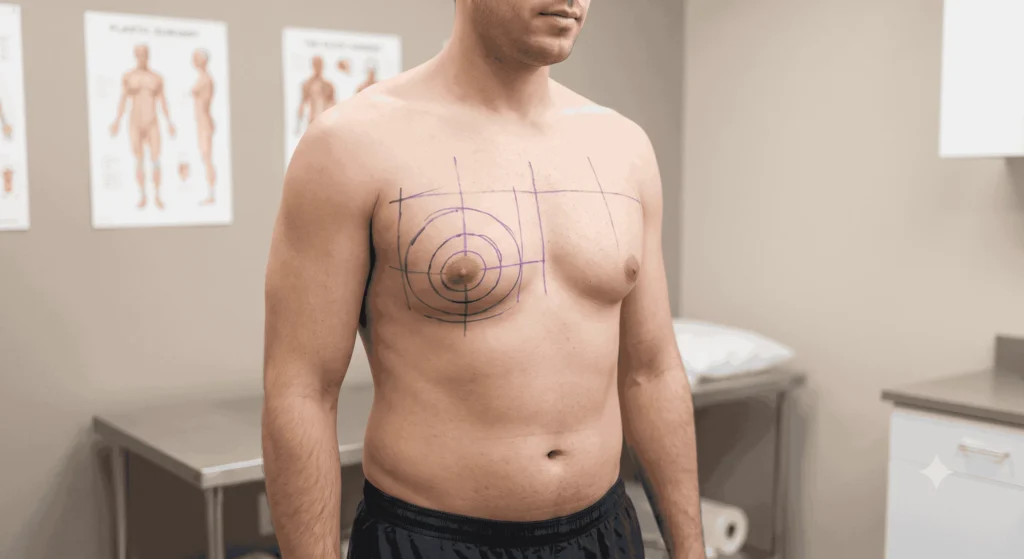
When Can You Return to Work After Gynecomastia Surgery?
This depends heavily on what you do for work.
Desk or Office Work
People with desk-based jobs may be able to return relatively early if they are comfortable and their surgeon approves.
A straightforward procedure may allow return within several days to around a week.
Physical Jobs
If your work involves:
- Heavy lifting
- Repetitive arm movements
- Construction
- Manufacturing
- Loading or unloading
- Manual labour
- Significant upper-body activity
you may require more time away from work.
Discuss your occupation with your surgeon before surgery so your recovery can be planned realistically.
When Can You Drive After Gynecomastia Surgery?
Driving should not be resumed simply because you feel comfortable sitting in a car.
You need to be capable of safely:
- Turning the steering wheel
- Reacting quickly
- Moving your arms without significant restriction
- Wearing a seat belt comfortably
- Performing emergency movements if necessary
You should also not drive while taking medications that impair alertness or reaction time.
Ask your surgeon when it is safe for you to resume driving based on your procedure and recovery.
When Can You Go Back to the Gym?
This is one of the most common questions after gynecomastia surgery.
The answer is: gradually and with your surgeon’s approval.
Exercise progression may broadly look like:
Early recovery: Gentle walking
Around the second week: Light activity or cardio may be permitted in some uncomplicated cases
Following weeks: Lower-body and moderate exercise may gradually increase
Around 4–6 weeks or later: Upper-body and chest workouts may be reintroduced if the surgeon confirms adequate healing
These are general ranges rather than instructions for an individual patient.
Some procedures require longer restrictions.
Why Should You Avoid Chest Workouts Too Early?
Exercises such as:
- Bench press
- Push-ups
- Chest flyes
- Dips
- Cable crossovers
- Heavy shoulder presses
place stress on the chest and surrounding tissues.
Returning too early may increase swelling or place unnecessary stress on healing tissues and incisions.
Feeling strong enough to exercise does not necessarily mean the surgical area has fully healed.
When Can You Start Push-Ups After Gynecomastia Surgery?
Push-ups heavily involve the pectoral muscles.
They should therefore not be treated as a light exercise during early recovery.
Wait until your surgeon specifically clears you for upper-body and chest exercise.
When cleared, it is generally sensible to return progressively rather than immediately attempting your previous number of repetitions.
Why Is a Compression Garment Used After Gynecomastia Surgery?
Compression garments are commonly used after male breast reduction surgery.
They may help:
- Control swelling
- Support healing tissues
- Provide postoperative support
- Help the skin and tissues adapt to the new chest contour
The amount of time a compression garment should be worn varies according to the procedure and surgeon.
Some protocols recommend several weeks of compression.
Follow the schedule given by your surgeon rather than stopping simply because the chest feels better.
Should You Wear a Compression Garment While Sleeping?
During the initial recovery period, some surgeons recommend wearing the garment for most or all of the day, including during sleep.
The schedule may then be reduced as recovery progresses.
Because postoperative protocols differ, your own surgeon’s instructions should take priority over a generic online schedule.
How Should You Sleep After Gynecomastia Surgery?
Your surgeon may recommend sleeping on your back during early recovery to avoid unnecessary pressure on the chest.
Some patients also find sleeping with their upper body slightly elevated more comfortable during the initial swelling period.
Avoid sleeping directly on your chest until your surgeon confirms that it is appropriate.
How Long Does Swelling Last After Gynecomastia Surgery?
Swelling is expected after surgery.
A large portion may improve during the first several weeks, but residual swelling can persist longer.
You may notice that:
- One side appears more swollen
- The chest feels firm
- The nipple area looks temporarily uneven
- Contour changes from week to week
These changes do not automatically mean something is wrong.
The tissues need time to heal and settle.
However, sudden or significant changes should be discussed with your surgeon.

When Will You See the Final Result?
You may notice an immediate reduction in chest volume after surgery, but this is not the final result.
Swelling and tissue firmness can temporarily affect chest shape.
As swelling gradually resolves, the chest contour becomes easier to assess.
Final refinement may take several months, and scars can continue maturing for considerably longer.
Patience is therefore an important part of gynecomastia surgery recovery.
What Happens to the Scars?
The location and length of scars depend on the surgical technique.
When glandular tissue is removed, an incision may be placed along part of the edge of the areola.
Liposuction requires small access incisions.
Patients with substantial excess skin may require larger incisions.
Early scars may appear darker, pinker or more noticeable before gradually maturing.
Your surgeon may recommend a scar-care protocol once the incisions have healed sufficiently.
What Should You Avoid During Recovery?
Your surgeon will provide specific restrictions, but common precautions may include avoiding:
- Heavy lifting too early
- Chest workouts before clearance
- Strenuous physical activity during early recovery
- Pressure or trauma to the chest
- Smoking
- Ignoring compression-garment instructions
- Picking at healing incisions
- Missing follow-up appointments
Do not change prescribed medication or wound-care instructions without discussing it with your medical team.
What Are Possible Complications After Gynecomastia Surgery?
Most patients recover without major problems, but gynecomastia surgery, like any surgical procedure, carries risks.
Potential complications can include:
- Bleeding or hematoma
- Fluid accumulation or seroma
- Infection
- Delayed wound healing
- Scarring
- Changes in nipple sensation
- Asymmetry
- Contour irregularities
- Skin or nipple-related complications
Your surgeon should discuss relevant risks with you before the procedure.
When Should You Contact Your Surgeon?
Contact your medical team if you experience unexpected or concerning symptoms during recovery.
These can include:
- Rapidly increasing swelling
- Significant one-sided swelling
- Persistent or worsening pain
- Excessive bleeding
- Concerning wound changes
- Signs of infection
- Unexpected nipple or skin changes
- Any symptom specifically listed in your postoperative instructions
Seek urgent medical attention for symptoms such as chest pain, shortness of breath or an abnormal heartbeat.
How Can You Support a Smooth Recovery?
Successful recovery is not about trying to heal as quickly as possible.
It is about allowing the body sufficient time to heal properly.
Follow your surgeon’s instructions regarding:
- Activity
- Compression
- Medication
- Wound care
- Exercise
- Follow-up appointments
Do not compare your recovery day-by-day with another patient’s experience.
Two people undergoing gynecomastia surgery can have different recovery timelines depending on the extent of their procedures.
Can You Build Your Chest After Gynecomastia Surgery?
Once healing is complete and your surgeon clears you for unrestricted exercise, chest training can be gradually resumed.
Building the pectoral muscles may further improve chest definition.
The important point is timing.
Do not rush back into heavy bench presses or push-ups simply because you want to maintain your physique.
Allow the surgical tissues to heal first, then progressively rebuild your training intensity.
Gynecomastia Surgery Recovery at Morph Aesthetic
At Morph Aesthetic, postoperative care is an important part of the overall gynecomastia treatment process.
Recovery recommendations should be individualized according to the surgical technique, amount of tissue removed and each patient’s healing progress.
If you are considering gynecomastia surgery in Ahmedabad, a consultation can help you understand not only the procedure but also the expected downtime, return-to-work considerations, compression requirements and realistic timeline for returning to the gym.
Schedule a consultation with Morph Aesthetic to discuss a treatment and recovery plan based on your individual condition.
EXCELLENTTrustindex verifies that the original source of the review is Google. Good experiencePosted on GoogleTrustindex verifies that the original source of the review is Google. It is a very good clinic with a very helpful staff and extremely clean. It gives u a personalized experience and comfort like never before❣️Posted on GoogleTrustindex verifies that the original source of the review is Google. good behaviour and nice counsaltuntPosted on GoogleTrustindex verifies that the original source of the review is Google. Had a great experience with dr Ronak and dr dhaval for surgery , sakshi ma’am and dr shruti also served us meticulously.Posted on GoogleTrustindex verifies that the original source of the review is Google. Excellent service and amazing result. Highly recommend morph anesthetic. Professional staff.great care.and a wonderful experience. Best plastic surgeon in Ahmedabad.Posted on GoogleTrustindex verifies that the original source of the review is Google. Very nice service..Posted on GoogleTrustindex verifies that the original source of the review is Google. I recently had my child's surgery done at Morph Aesthetic Clinic by Dr. Dhaval Vanzara and Dr. Ronak Kadia, and I couldn't be happier. Both doctors are exceptionally skilled and professional. Before the procedure, they explained everything to me so clearly, and the final result is exactly what I expected and hoped for. Beyond their expertise, both doctors have a wonderful, kind, and supportive nature. Highly recommend this clinic for their outstanding care and perfect results.Posted on GoogleTrustindex verifies that the original source of the review is Google. Nice and clean work and dr is so humble and passionate for work and so good for attend the patient