
Hair Transplant in Ahmedabad: Cost, Procedure & Why Morph Aesthetic is the Best Clinic in 2026
Hair loss is one of the most common — and most confidence-affecting — conditions that people in Ahmedabad deal with silently. Whether it is a gradually receding hairline noticed in your thirties, a thinning crown that grows more visible each year, or the sudden shock of significant hair loss after illness or stress — the psychological impact of hair loss is real, significant, and often underestimated.
The good news in 2026: hair transplant in Ahmedabad has become one of the most accessible, most advanced, and most consistently successful cosmetic procedures available. With techniques like FUE (Follicular Unit Extraction) producing results that are genuinely indistinguishable from natural hair, and expert surgeons delivering precision outcomes that hold for a lifetime, hair restoration is no longer a procedure to hesitate about.
This complete guide covers everything you need to know before making your decision: what a hair transplant involves, the techniques available, realistic costs in Ahmedabad, what recovery looks like, and why Morph Aesthetic Clinic in Sola, Ahmedabad — led by Dr. Ronak Kadia and Dr. Dhaval Vanzara — is the clinic that Ahmedabad residents consistently trust for permanent, natural-looking hair restoration.
Understanding Hair Loss: Why It Happens and When a Transplant Is the Answer
Before exploring the procedure, it helps to understand why hair loss occurs and when a transplant is genuinely the right solution — as opposed to medical management.
Common Causes of Hair Loss in Ahmedabad Patients
Androgenetic Alopecia (Male and Female Pattern Baldness): By far the most common cause. Driven by genetics and the hormone DHT (Dihydrotestosterone), this type of hair loss follows predictable patterns — the Norwood scale for men (receding temples, thinning crown) and the Ludwig scale for women (diffuse thinning on top). Once follicles miniaturise and stop producing hair, no medication can revive them. A hair transplant is the only permanent solution.
Stress-Induced Hair Loss (Telogen Effluvium): Major physical or emotional stress can push large numbers of follicles simultaneously into the resting (telogen) phase, causing diffuse shedding 2–3 months after the triggering event. Often reversible with treatment, but if shedding has been prolonged or follicles have been damaged, transplantation may be needed.
Traction Alopecia: Hair loss caused by prolonged tension on the follicles — common in women who wear tight hairstyles. If detected early, reversible. If chronic, permanent follicle damage occurs and transplant is the solution.
Post-Illness or Post-COVID Hair Loss: Significant hair shedding following major illnesses, surgeries, or COVID-19 infection is now well-documented. Where loss is permanent, targeted transplantation restores affected areas.
Scarring Alopecia (Burn, Trauma, or Surgical Scars): Scars from burns, accidents, or previous surgeries may permanently destroy follicles in affected areas. FUE hair transplant techniques can restore hair growth in scarred areas, improving both appearance and confidence.
When Is a Hair Transplant the Right Choice?
A hair transplant is recommended when:
- Hair loss has stabilised (not actively progressive)
- The donor area (back and sides of scalp) has adequate, healthy hair density
- Medical treatments (minoxidil, finasteride, PRP) have been tried and show insufficient results
- The patient has realistic expectations about outcomes and coverage
- There is a clear cosmetic or functional reason for restoration
At Morph Aesthetic, Dr. Ronak Kadia and Dr. Dhaval Vanzara conduct a thorough evaluation before recommending transplantation — ensuring it is genuinely the right solution for your specific pattern, density, and expectations.
Hair Transplant in Ahmedabad: Advanced Techniques Available at Morph Aesthetic
FUE — Follicular Unit Extraction (Gold Standard)
FUE is the most widely used and most advanced hair transplant technique in 2026 — and is the primary technique at Morph Aesthetic Clinic in Ahmedabad.
How FUE works:
Step 1 — Donor Area Preparation The donor area (typically the back and sides of the scalp, where follicles are genetically resistant to DHT and permanent) is identified, assessed for density, and the hair is trimmed short. Local anaesthesia is administered — the procedure is virtually painless.
Step 2 — Individual Follicle Extraction Using a precision micro-punch tool (0.6–0.9 mm diameter), individual follicular units (containing 1–4 hairs each) are extracted one by one. The precision of extraction is critical — follicles must be removed intact, with their bulb and surrounding tissue, to survive transplantation. This is where surgical expertise matters enormously.
Step 3 — Graft Sorting and Preservation Extracted follicular units are sorted by a skilled team under magnification — single-hair grafts for hairline naturalness, 2–3 hair grafts for density behind the hairline. Grafts are stored in a specialised preservation solution to maintain viability.
Step 4 — Recipient Site Creation Tiny incisions are made in the recipient area (receding hairline, crown, or bald patches) at precise angles and directions to match natural hair growth patterns. This artistic step defines how natural the final result will appear.
Step 5 — Graft Implantation Grafts are meticulously placed into each recipient site — matching the natural angle, direction, and density of surrounding hair. This precision placement is what makes results look genuinely natural.
FUE advantages:
- No linear scar — tiny, circular donor marks heal invisibly
- Comfortable recovery — 7–10 days of mild soreness
- Can wear hair short or shaved without visible scarring
- Suitable for beard, eyebrow, and moustache transplants in addition to scalp
FUT — Follicular Unit Transplantation (Strip Method)
FUT involves removing a strip of scalp from the donor area, dissecting it into individual follicular units, and transplanting them to recipient sites.
When FUT is considered:
- When a very large number of grafts (4,000+) is needed in a single session
- When the donor area has limited density for individual extraction
- When maximum coverage is required and hairline scar from FUT is acceptable
FUT consideration: Leaves a linear scar at the donor site — visible if the head is shaved. FUE is preferred by most Ahmedabad patients for this reason.
Beard and Moustache Hair Transplant
For men with patchy facial hair, sparse beard growth, or scars affecting facial hair, Morph Aesthetic’s beard transplant uses scalp hair follicles to fill and define the cheek, jawline, moustache, and chin areas. Results are permanent, natural in texture, and can be shaped and styled freely after healing.
Eyebrow Hair Transplant
Thinning or over-plucked eyebrows can be fully restored with precision eyebrow transplantation at Morph Aesthetic. Fine, single-hair grafts are placed with exact angle and direction to recreate natural eyebrow density and shape.
PRP and GFC Therapy — Enhancing Transplant Results
Morph Aesthetic enhances hair transplant outcomes with:
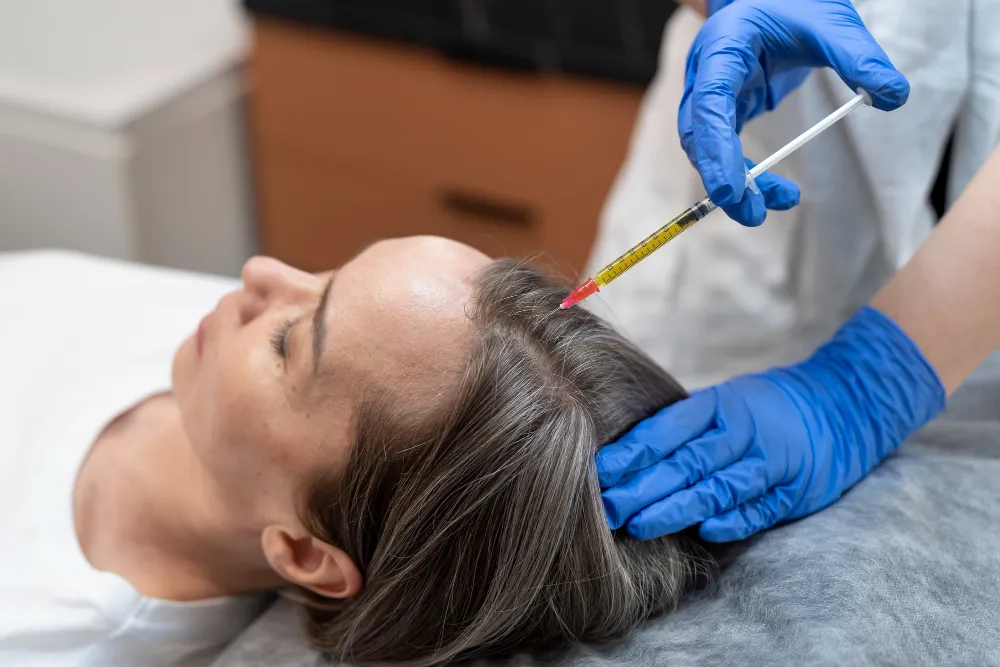
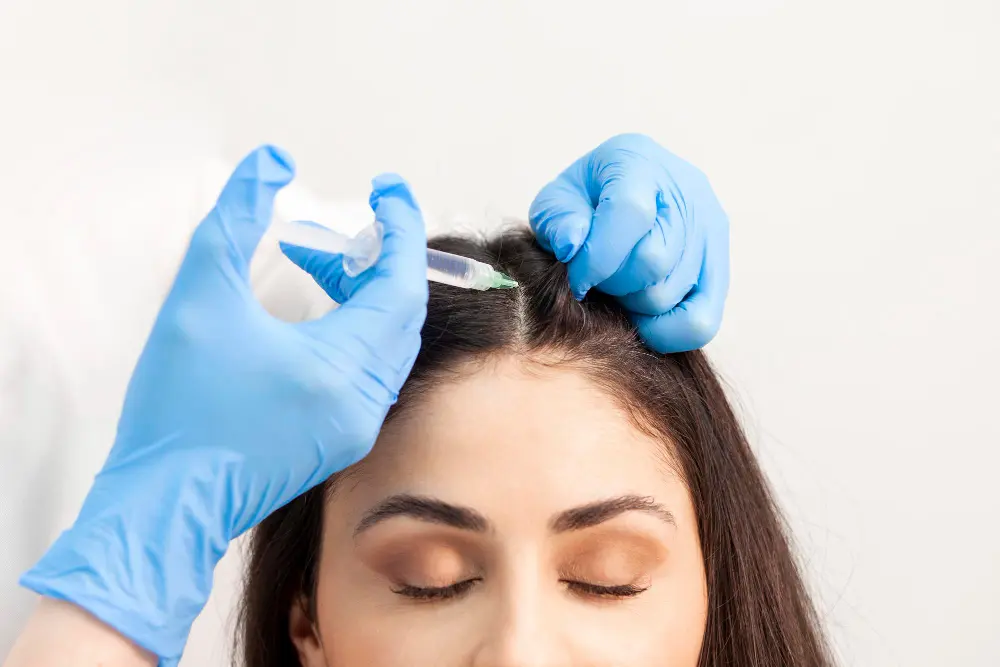
PRP (Platelet-Rich Plasma) Therapy: Your own blood is processed to concentrate platelets and growth factors, which are injected into the scalp to stimulate follicle activity, improve healing, and boost transplanted graft survival.
GFC (Growth Factor Concentrate): A more advanced form of PRP using concentrated growth factors to actively stimulate hair regeneration. Used both alongside transplants and as a standalone non-surgical hair growth treatment.
Hair Transplant Techniques Available at Morph Aesthetic, Ahmedabad
FUE — Follicular Unit Extraction (Gold Standard)
FUE is the most widely used and most advanced hair transplant technique in 2026 — and is the primary technique at Morph Aesthetic Clinic in Ahmedabad.
How FUE works:
Step 1 — Donor Area Preparation The donor area (typically the back and sides of the scalp, where follicles are genetically resistant to DHT and permanent) is identified, assessed for density, and the hair is trimmed short. Local anaesthesia is administered — the procedure is virtually painless.
Step 2 — Individual Follicle Extraction Using a precision micro-punch tool (0.6–0.9 mm diameter), individual follicular units (containing 1–4 hairs each) are extracted one by one. The precision of extraction is critical — follicles must be removed intact, with their bulb and surrounding tissue, to survive transplantation. This is where surgical expertise matters enormously.
Step 3 — Graft Sorting and Preservation Extracted follicular units are sorted by a skilled team under magnification — single-hair grafts for hairline naturalness, 2–3 hair grafts for density behind the hairline. Grafts are stored in a specialised preservation solution to maintain viability.
Step 4 — Recipient Site Creation Tiny incisions are made in the recipient area (receding hairline, crown, or bald patches) at precise angles and directions to match natural hair growth patterns. This artistic step defines how natural the final result will appear.
Step 5 — Graft Implantation Grafts are meticulously placed into each recipient site — matching the natural angle, direction, and density of surrounding hair. This precision placement is what makes results look genuinely natural.
FUE advantages:
- No linear scar — tiny, circular donor marks heal invisibly
- Comfortable recovery — 7–10 days of mild soreness
- Can wear hair short or shaved without visible scarring
- Suitable for beard, eyebrow, and moustache transplants in addition to scalp
FUT — Follicular Unit Transplantation (Strip Method)
FUT involves removing a strip of scalp from the donor area, dissecting it into individual follicular units, and transplanting them to recipient sites.
When FUT is considered:
- When a very large number of grafts (4,000+) is needed in a single session
- When the donor area has limited density for individual extraction
- When maximum coverage is required and hairline scar from FUT is acceptable
FUT consideration: Leaves a linear scar at the donor site — visible if the head is shaved. FUE is preferred by most Ahmedabad patients for this reason.
Beard and Moustache Hair Transplant
For men with patchy facial hair, sparse beard growth, or scars affecting facial hair, Morph Aesthetic’s beard transplant uses scalp hair follicles to fill and define the cheek, jawline, moustache, and chin areas. Results are permanent, natural in texture, and can be shaped and styled freely after healing.
Eyebrow Hair Transplant
Thinning or over-plucked eyebrows can be fully restored with precision eyebrow transplantation at Morph Aesthetic. Fine, single-hair grafts are placed with exact angle and direction to recreate natural eyebrow density and shape.
PRP and GFC Therapy — Enhancing Transplant Results
Morph Aesthetic enhances hair transplant outcomes with:
PRP (Platelet-Rich Plasma) Therapy: Your own blood is processed to concentrate platelets and growth factors, which are injected into the scalp to stimulate follicle activity, improve healing, and boost transplanted graft survival.
GFC (Growth Factor Concentrate): A more advanced form of PRP using concentrated growth factors to actively stimulate hair regeneration. Used both alongside transplants and as a standalone non-surgical hair growth treatment.
Hair Transplant Cost in Ahmedabad: What to Expect in 2026
Hair transplant cost in Ahmedabad is primarily determined by the number of grafts required — which depends on the size of the area being covered and the density desired.
Approximate Cost Range at Morph Aesthetic, Ahmedabad
Norwood Grade / Area | Grafts Required | Approximate Cost Range |
Grade II (Early recession) | 800–1,500 grafts | ₹40,000–₹75,000 |
Grade III (Moderate recession) | 1,500–2,500 grafts | ₹75,000–₹1,25,000 |
Grade IV (Advanced recession) | 2,500–3,500 grafts | ₹1,25,000–₹1,75,000 |
Grade V–VI (Extensive baldness) | 3,500–5,000 grafts | ₹1,75,000–₹2,50,000 |
Beard transplant | 500–2,000 grafts | ₹30,000–₹1,00,000 |
Eyebrow transplant | 200–400 grafts per side | ₹30,000–₹60,000 |
Note: Above ranges are indicative. Exact cost is determined at your consultation after Dr. Ronak Kadia or Dr. Dhaval Vanzara assesses your hair loss pattern, donor density, and desired outcome. Morph Aesthetic provides transparent, no-pressure pricing.
What Is Included in the Cost?
At Morph Aesthetic, the hair transplant cost includes:
- Pre-operative scalp and donor assessment
- Local anaesthesia for the entire procedure
- Surgeon fees (Dr. Ronak Kadia / Dr. Dhaval Vanzara)
- Graft extraction, sorting, and implantation
- Post-operative medications and care kit
- Follow-up consultations during the healing and growth period
Why Cheaper Is Not Better for Hair Transplants
Hair transplant outcomes are lifetime decisions. The quality of the surgeon’s technique — particularly in hairline design, graft extraction survival rate, and recipient site angulation — determines results that you will live with for decades. At Morph Aesthetic, the procedures are performed directly by Dr. Ronak Kadia and Dr. Dhaval Vanzara — not delegated to technicians, as is common at lower-cost centres.
Hair Transplant Recovery: A Realistic Timeline
Understanding what recovery looks like helps you plan appropriately and set accurate expectations.
Week 1 — Post-Procedure
- Mild redness, swelling, and soreness at both donor and recipient areas — normal and expected
- Tiny scabs form around each transplanted graft — do not touch or pick
- Gentle scalp washing with prescribed shampoo from Day 3 onwards
- Avoid strenuous activity, direct sunlight, and swimming
- Most patients take 5–7 days off work
Week 2–3 — Shedding Phase
- Transplanted hairs begin to shed — this is completely normal and expected
- The shed hairs are not the follicles — the follicles remain in the scalp and are entering a resting phase
- This temporary shedding can feel disheartening — it is a normal part of the process
Month 1–3 — Dormant Phase
- The scalp appears similar to before the procedure — follicles are dormant
- Avoid cutting or shaving the recipient area
- PRP sessions can be done from Month 1 to accelerate growth
Month 3–6 — Early Growth
- New hair begins to emerge — initially fine and light in texture
- Progressive thickening and darkening over subsequent months
Month 6–9 — Visible Transformation
- Significant new hair growth visible — most patients see 60–70% of final results
- Hair continues to mature, thicken, and settle into natural direction
Month 9–12 — Final Results
- Full, mature results achieved
- Transplanted hair grows permanently — exactly like natural hair
- Can be cut, styled, coloured, and treated exactly as native hair
Why Choose Morph Aesthetic for Hair Transplant in Ahmedabad?
Expert Surgeons — Dr. Ronak Kadia and Dr. Dhaval Vanzara
Morph Aesthetic is led by two specialist plastic surgeons who personally perform every hair transplant procedure. This is a critical distinction — at many hair transplant centres in Ahmedabad, extractions and implantations are performed by technicians rather than qualified surgeons.
Dr. Ronak Kadia and Dr. Dhaval Vanzara bring deep expertise in both the surgical technique and the aesthetic artistry of hair restoration — understanding not just how to transplant hair, but how to design a hairline that looks age-appropriate, natural, and harmonious with your facial structure.
Precision-Driven, Personalised Approach
No two hair loss patterns are identical. At Morph Aesthetic, every hair transplant plan is custom-designed — considering your current hair loss grade, donor density, the area to be covered, future hair loss trajectory, and your personal aesthetic goals. The hairline is designed collaboratively with you before the procedure.
Transparent, Honest Consultation
Multiple patients highlight in their reviews that Morph Aesthetic’s doctors provide honest, non-pressured consultations. “Dr. Dhaval provided practical and appropriate suggestions without any marketing pressure or attempts to oversell treatments.”
At Morph Aesthetic, if a hair transplant is not the right solution for your stage of hair loss, you will be told — and directed toward the appropriate medical management instead.
24/7 Surgeon Accessibility
Unlike large institutional clinics where follow-up questions go to nurses or receptionists, Morph Aesthetic patients consistently report that Dr. Ronak Kadia and Dr. Dhaval Vanzara remain personally accessible for queries throughout the recovery and growth period.
Conveniently Located at Sola, Ahmedabad
Morph Aesthetic Clinic is located at Sola, Ahmedabad — easily accessible from across the city including Satellite, Bopal, Chandkheda, Navrangpura, Science City, and surrounding areas.
Conclusion
Hair transplant in Ahmedabad has reached a level of sophistication in 2026 that makes permanent, natural-looking hair restoration a genuinely achievable goal for anyone dealing with pattern baldness, receding hairlines, or significant hair thinning.
The key to exceptional results is not the technique alone — it is the expertise of the surgeon designing and executing the procedure.
At Morph Aesthetic Clinic, Sola, Ahmedabad, Dr. Ronak Kadia and Dr. Dhaval Vanzara bring the precision, artistry, and patient-centred care that consistently produce results that their patients describe as life-changing. Not just aesthetically — but in confidence, self-image, and quality of life.
Ready to take the first step toward restoring your hair and your confidence?
Book your personalised consultation at Morph Aesthetic Clinic, Sola, Ahmedabad today.
EXCELLENTTrustindex verifies that the original source of the review is Google. Good experiencePosted on GoogleTrustindex verifies that the original source of the review is Google. It is a very good clinic with a very helpful staff and extremely clean. It gives u a personalized experience and comfort like never before❣️Posted on GoogleTrustindex verifies that the original source of the review is Google. good behaviour and nice counsaltuntPosted on GoogleTrustindex verifies that the original source of the review is Google. Had a great experience with dr Ronak and dr dhaval for surgery , sakshi ma’am and dr shruti also served us meticulously.Posted on GoogleTrustindex verifies that the original source of the review is Google. Excellent service and amazing result. Highly recommend morph anesthetic. Professional staff.great care.and a wonderful experience. Best plastic surgeon in Ahmedabad.Posted on GoogleTrustindex verifies that the original source of the review is Google. Very nice service..Posted on GoogleTrustindex verifies that the original source of the review is Google. I recently had my child's surgery done at Morph Aesthetic Clinic by Dr. Dhaval Vanzara and Dr. Ronak Kadia, and I couldn't be happier. Both doctors are exceptionally skilled and professional. Before the procedure, they explained everything to me so clearly, and the final result is exactly what I expected and hoped for. Beyond their expertise, both doctors have a wonderful, kind, and supportive nature. Highly recommend this clinic for their outstanding care and perfect results.Posted on GoogleTrustindex verifies that the original source of the review is Google. Nice and clean work and dr is so humble and passionate for work and so good for attend the patient