


Gynecomastia in Young Men: Why Gym & Weight Loss May Not Fix an Enlarged Chest
You lose weight.
You train your chest regularly.
Your shoulders become broader, your body-fat percentage comes down and your physique becomes noticeably leaner.
But one problem remains:
the chest still looks puffy or enlarged, particularly around the nipples.
For some young men, the problem is not simply stubborn chest fat. It may be gynecomastia, which involves enlargement of male breast glandular tissue. This is different from pseudogynecomastia, where chest enlargement is mainly due to excess fat. Current clinical guidance stresses that distinguishing the two is an important first step because their treatment is different.
That distinction explains why months of chest workouts can dramatically change one man’s chest but make surprisingly little difference to another’s.
What Is Gynecomastia?
Gynecomastia is a benign enlargement of glandular breast tissue in males. It develops when the hormonal environment affecting breast tissue shifts toward greater estrogen activity relative to androgen activity. It can occur during adolescence as a physiological process or develop later because of medications, hormonal disorders, substances or other medical conditions.
Gynecomastia may involve:
- One or both sides of the chest
- A firm or rubbery area beneath the nipple
- Puffy or projected nipples
- Tenderness, particularly in newer cases
- A chest contour that remains prominent despite overall weight loss
It should not be confused with simply having a higher body-fat percentage.

Gynecomastia vs Chest Fat: Why the Difference Matters
This is the biggest source of confusion among gym-going men.
Pseudogynecomastia
Pseudogynecomastia is enlargement caused mainly by fat without enlargement of the glandular breast component. It is more common in men who are overweight or have higher body fat. Weight reduction can therefore reduce chest volume when fat is the dominant problem.
True Gynecomastia
True gynecomastia involves actual glandular tissue under the nipple-areola area. Current guidance describes this tissue as a palpable, elastic, tender or firm subareolar mass, whereas pseudogynecomastia lacks this glandular disc.
This creates an important practical difference:
Chest fat can decrease when overall body fat decreases.
Established glandular tissue does not simply behave like stored body fat.
So someone can become significantly leaner and still have noticeable fullness behind the nipple.
Why Can Someone Look Fit and Still Have Gynecomastia?
Because being muscular and having gynecomastia are not mutually exclusive.
A man may have:
- Low overall body fat
- Developed pectoral muscles
- Visible abdominal definition
- Good fitness levels
and still have glandular breast tissue.
Building the pectoral muscles underneath that tissue can improve the overall chest shape, but it does not directly remove the gland itself.
In some very muscular men, the contrast can actually make the nipple-area fullness more noticeable.
This is why “just do more chest exercises” is poor advice when the underlying problem is glandular rather than excess fat.
Why Does Gynecomastia Develop in Young Men?
There is no single cause.
A proper assessment should consider age, onset, medications, supplements or performance-enhancing drugs, medical history and hormonal symptoms. Updated 2026 clinical guidelines specifically recommend a structured history and physical examination before deciding whether additional hormonal or imaging investigations are required.
Some of the more relevant causes in younger men include the following.
1. Puberty and Hormonal Changes
Gynecomastia is common during adolescence because the relative effects of estrogen and testosterone can fluctuate during puberty.
Many cases of pubertal gynecomastia improve spontaneously, which is why observation is often appropriate rather than rushing directly into surgery. Current guidance recommends generally postponing surgery until after puberty unless there is substantial persistent psychological distress or another compelling clinical reason.
The situation changes when chest enlargement:
- Persists well beyond puberty
- Remains stable for years
- Becomes fibrotic
- Produces persistent cosmetic or psychological concern
Long-standing gynecomastia is less likely to regress spontaneously than a newly developed pubertal case.
2. Anabolic Steroids and Performance-Enhancing Hormones
This is particularly relevant for gym-going men.
Anabolic-androgenic steroids and other hormone-based performance-enhancing substances can disturb the balance between androgen and estrogen activity.
Some externally administered androgens can be converted into estrogens through aromatization, contributing to breast gland stimulation in susceptible men. The 2026 SIAMS guideline specifically lists anabolic agents and other sport-performance hormonal therapies among drug-related causes of gynecomastia.
Endotext similarly documents gynecomastia among bodybuilders and athletes using aromatizable androgens.
This is different from simply saying:
“Gym supplements cause gynecomastia.”
That statement is too broad.
A detailed history should distinguish ordinary nutrition products from hormonal or performance-enhancing substances capable of affecting endocrine function.
If gynecomastia appears after steroid or hormone use, disclose that information to the doctor. Hiding it makes proper assessment harder.
3. Certain Medicines Can Cause Gynecomastia
Gynecomastia can also be medication-related.
Several drugs can interfere with testosterone production or action, estrogen activity or other hormonal pathways. Updated guidance therefore recommends reviewing the patient’s complete medication history rather than treating the chest enlargement purely as a cosmetic problem.
This is one reason you should not stop a prescription medication on your own just because gynecomastia develops.
The prescribing doctor and treating specialist should determine whether the medicine is likely to be contributing and whether an alternative is appropriate.
4. Obesity Can Complicate the Picture
Obesity can increase chest fat and create pseudogynecomastia, but it may also influence the hormonal environment associated with true gynecomastia.
Current guidelines note that obesity is associated with increased aromatase activity and can alter the balance between estrogens and androgens.
This means some men have a mixed problem:
excess chest fat + glandular tissue
In such a case, weight loss may improve the fat component but leave the glandular prominence behind.
That is why the chest may look better after losing 10 or 15 kilograms without becoming completely flat.
5. Hormonal or Medical Conditions
Most young men with gynecomastia do not have a dangerous underlying disease, but that does not mean medical causes should simply be ignored.
Depending on the history and examination, doctors may investigate conditions affecting:
- Testosterone production
- Estrogen activity
- Thyroid function
- Liver function
- Kidney function
- Testicular health
Current guidelines recommend targeted diagnostic work-up when the history or examination suggests an underlying endocrine or systemic cause.
The correct approach is therefore:
Diagnose first. Treat second.
Can Chest Exercises Remove Gynecomastia?
Not if true glandular gynecomastia is the main issue.
Training exercises such as:
- Bench press
- Push-ups
- Incline press
- Dumbbell flyes
- Cable crossovers
can strengthen and enlarge the pectoralis muscles.
They can also support overall fat loss when combined with appropriate nutrition and training.
But exercise does not selectively dissolve glandular breast tissue.
This is why a man may develop an impressive chest musculature while still seeing puffy nipples or a rounded contour over the lower chest.

What If the Problem Is Mostly Chest Fat?
Then fat reduction deserves a genuine chance.
Morph Aesthetic distinguishes pseudogynecomastia from true gynecomastia and notes that weight management is a first-line approach when excess fat is responsible for the chest enlargement. Liposuction may be considered for persistent localized fat when appropriate.
If you are overweight, reducing body fat before assuming you need gynecomastia surgery can also make the underlying chest anatomy easier to assess.
But if you are already lean and there is persistent firm fullness beneath the nipple, simply becoming even leaner may not solve it.
Why Do Puffy Nipples Remain Even After Weight Loss?
This is a common presentation of glandular gynecomastia.
A relatively small amount of glandular tissue positioned directly beneath the nipple can push the nipple-areola complex outward.
The overall chest may not look dramatically large.
Instead, the main complaint is:
“My chest is flat, but my nipples still look puffy.”
This can occur even in otherwise lean men.
Whether the prominence is glandular, fatty or mixed should be determined clinically rather than diagnosed from photographs or social-media comparisons.
Can You Diagnose Gynecomastia Yourself?
Not reliably.
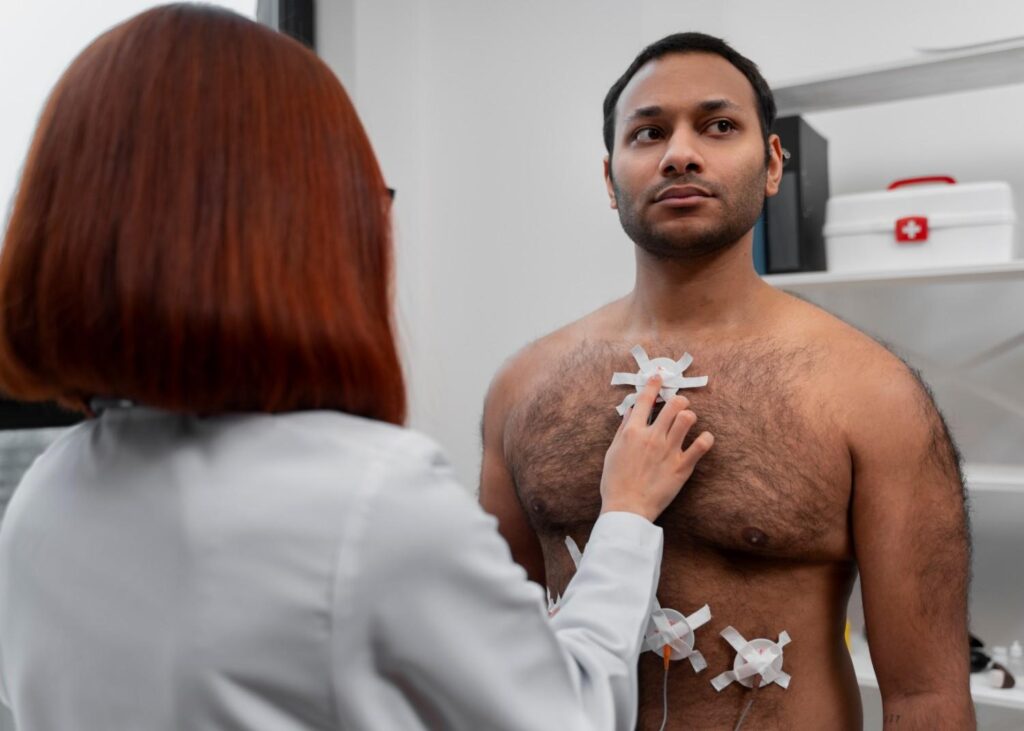
A doctor will usually begin with a physical examination, looking at:
- Location of tissue
- Firmness
- Symmetry
- Tenderness
- Chest fat distribution
- Nipple and skin changes
Current guidelines state that careful physical examination can distinguish gynecomastia from pseudogynecomastia in many cases. When the examination is unclear, ultrasound can be useful for differentiating glandular tissue from fat.
Morph Aesthetic also describes clinical examination and selective imaging or hormonal investigation as part of differentiating true gynecomastia from pseudogynecomastia.
When Does a Chest Lump Need Proper Medical Evaluation?
Most gynecomastia is benign.
Still, a new male breast lump should not automatically be labelled gynecomastia.
Features that deserve medical evaluation include:
- A distinctly hard mass
- A lump away from the nipple
- Significant asymmetry
- Nipple retraction
- Bloody nipple discharge
- Skin changes
- Enlarged lymph nodes
Endotext notes that gynecomastia generally produces tissue concentrated around the nipple, whereas suspicious male breast lesions may be harder, more peripheral and associated with nipple or skin changes.
That does not mean these symptoms automatically indicate cancer. It means they should be examined rather than self-diagnosed.
Can Gynecomastia Go Away Without Surgery?
Sometimes.
Whether it can regress depends strongly on the cause and duration.
Newer physiological gynecomastia, particularly during puberty, may resolve spontaneously. Treating an underlying drug, hormonal or medical cause may also improve some cases.
Long-standing gynecomastia is different.
As glandular tissue becomes more fibrotic over time, spontaneous regression and response to medical treatment become less likely. Current 2026 guidelines recommend surgery for appropriate patients with long-standing fibrotic gynecomastia that does not regress or respond to suitable medical treatment, particularly when the condition causes substantial distress.
Do Medicines Treat Gynecomastia?
Medical treatment can be considered in selected recent-onset or painful cases, but it is not a universal solution for every man with a long-standing enlarged chest.
Endotext notes that medical therapy is generally most relevant in severe, recent-onset gynecomastia when there is no readily treatable underlying cause.
The 2026 SIAMS guidance similarly recommends individualized management and reserves pharmacological therapy for selected situations rather than routine treatment of every patient.
This matters because buying hormonal tablets online after watching a bodybuilding video is not safe treatment.
These medicines can have significant effects and should only be considered after appropriate medical evaluation.
When Is Gynecomastia Surgery Considered?
Surgery may be considered when:
- Gynecomastia has persisted for a long time
- Glandular tissue remains despite overall weight reduction
- The condition has stabilised after puberty
- Chest tenderness or physical discomfort persists
- Appearance causes significant distress
- Medical or underlying causes have been appropriately assessed
- The patient understands the procedure, limitations and recovery
The latest SIAMS guidance recommends tailoring surgical treatment according to the severity of gynecomastia, the amount of fatty tissue and individual patient factors
Liposuction vs Gland Excision: Which Is Needed?
This depends on what is actually creating the chest enlargement.
When Fat Is the Main Problem
Liposuction can remove localized fatty tissue and help contour the chest.
Morph Aesthetic currently describes liposuction as appropriate where excess fat is the dominant component.
When Glandular Tissue Is Significant
Firm glandular tissue may require surgical excision rather than relying on liposuction alone.
Morph’s current gynecomastia information notes that gland removal is used when glandular tissue is too significant for liposuction alone.
When Both Fat and Gland Are Present
Many patients have a mixed pattern.
In those cases, surgeons may combine liposuction for contouring with gland excision to address the glandular component.
The goal should not simply be “remove as much as possible.”
The surgical plan needs to create a natural chest contour while accounting for tissue thickness, skin quality and symmetry.
Is Gynecomastia Surgery Just Liposuction?
No.
This is one of the most important misconceptions.
Liposuction primarily removes fat.
If a substantial firm gland sits behind the nipple, liposuction alone may not completely flatten that area.
The American Society of Plastic Surgeons describes gynecomastia surgery as correction of enlarged male breasts and notes that the condition may involve localized fat, glandular tissue and sometimes excess skin.
The exact surgical technique therefore depends on what tissue is actually present.
What About Loose Skin?
Most younger men with mild or moderate gynecomastia have reasonably good skin elasticity.
More severe cases can involve stretched skin or enlargement of the areola.
The American Society of Plastic Surgeons notes that more advanced gynecomastia may require additional correction of excess skin or the nipple-areola position.
This is another reason two men with “gynecomastia” may require very different procedures.
Will Gynecomastia Come Back After Surgery?
Surgery removes the existing unwanted tissue, but future chest changes can still depend on the underlying cause.
For example, continued exposure to hormonal or anabolic substances that contributed to the original condition may create ongoing endocrine problems.
That is why identifying and addressing contributing factors matters before and after surgery, rather than treating the chest in isolation. Current guidelines specifically recommend reviewing drugs, anabolic agents and other potential causes during assessment.
Can You Go Back to the Gym After Gynecomastia Surgery?
Yes, after an appropriate recovery period, but not immediately.
Recovery recommendations depend on:
- Extent of surgery
- Whether liposuction was performed
- Amount of gland removed
- Skin treatment
- Healing
- Surgeon preference
Chest exercises and heavy lifting need to be resumed gradually according to the surgeon’s instructions.
Trying to return to heavy bench pressing too early is not a sign of faster recovery.
It is an unnecessary way to interfere with healing.
Why Gynecomastia Can Feel More Noticeable for Gym-Going Men
For some men, the issue is not that the chest is objectively very large.
It is the mismatch between the rest of the physique and the nipple-area contour.
Someone may work hard to become lean and muscular, yet continue wearing loose T-shirts because the nipple area remains projected.
Updated gynecomastia guidelines recognise that the condition can cause meaningful psychological and social distress, particularly among adolescents and young adults, and recommend that this impact be considered during treatment decisions.
Treatment should not be framed as medically necessary for every person with mild gynecomastia.
But it is equally wrong to dismiss persistent concern with:
“Just ignore it. It’s only cosmetic.”
The impact varies by person.
Should Every Gym-Going Man With Puffy Nipples Get Surgery?
No.
That would be poor medical advice.
A sensible pathway looks like this:
Step 1: Determine whether the enlargement is gland, fat or both
Step 2: Review age and whether puberty is complete
Step 3: Review medicines, anabolic agents and medical history
Step 4: Investigate hormonal or other causes when clinically indicated
Step 5: Allow appropriate observation or weight management when suitable
Step 6: Consider surgery for persistent, established cases where it is appropriate
That is far more rational than assuming every enlarged male chest requires gland removal.
Who May Be a Better Candidate for Gynecomastia Surgery?
Surgical assessment may make more sense when someone:
- Is past puberty
- Has persistent gynecomastia
- Has reasonably stable weight
- Has realistic expectations
- Has a chest contour that does not improve adequately with appropriate weight management
- Has significant glandular tissue
- Is medically suitable for elective surgery
- Understands scars and recovery
- Has addressed relevant underlying causes
The decision still needs individual examination.
No online checklist can confirm candidacy.
Gynecomastia Treatment in Ahmedabad at Morph Aesthetic
Morph Aesthetic currently provides assessment and treatment for gynecomastia and pseudogynecomastia in Ahmedabad, including surgical options selected according to whether the chest enlargement is predominantly fatty, glandular or mixed.
For a young or gym-going man, the important question is not:
“How many more chest workouts should I do?”
It is:
“Is this actually fat, glandular gynecomastia, or a combination of both?”
Once that is established, treatment becomes much more logical.
The Bottom Line: A Lean Body Does Not Rule Out Gynecomastia
If your chest remains enlarged despite consistent exercise and substantial fat loss, doing increasingly aggressive workouts may not solve the problem.
The explanation could be:
Mostly fat → further appropriate weight management may improve it
Mostly gland → exercise cannot directly remove the gland
Mixed fat + gland → both components need to be considered
Recent hormonal gynecomastia → observation or medical evaluation may be appropriate
Long-standing fibrotic gynecomastia → surgery may be considered in suitable patients
Modern gynecomastia treatment begins with identifying what is actually creating the chest prominence, not assuming every patient needs the same procedure.
For patients considering gynecomastia treatment in Ahmedabad, Morph Aesthetic offers evaluation to distinguish true gynecomastia from pseudogynecomastia and plan treatment accordingly.
FAQ's
EXCELLENTTrustindex verifies that the original source of the review is Google. Good experiencePosted on GoogleTrustindex verifies that the original source of the review is Google. It is a very good clinic with a very helpful staff and extremely clean. It gives u a personalized experience and comfort like never before❣️Posted on GoogleTrustindex verifies that the original source of the review is Google. good behaviour and nice counsaltuntPosted on GoogleTrustindex verifies that the original source of the review is Google. Had a great experience with dr Ronak and dr dhaval for surgery , sakshi ma’am and dr shruti also served us meticulously.Posted on GoogleTrustindex verifies that the original source of the review is Google. Excellent service and amazing result. Highly recommend morph anesthetic. Professional staff.great care.and a wonderful experience. Best plastic surgeon in Ahmedabad.Posted on GoogleTrustindex verifies that the original source of the review is Google. Very nice service..Posted on GoogleTrustindex verifies that the original source of the review is Google. I recently had my child's surgery done at Morph Aesthetic Clinic by Dr. Dhaval Vanzara and Dr. Ronak Kadia, and I couldn't be happier. Both doctors are exceptionally skilled and professional. Before the procedure, they explained everything to me so clearly, and the final result is exactly what I expected and hoped for. Beyond their expertise, both doctors have a wonderful, kind, and supportive nature. Highly recommend this clinic for their outstanding care and perfect results.Posted on GoogleTrustindex verifies that the original source of the review is Google. Nice and clean work and dr is so humble and passionate for work and so good for attend the patient