
PCOS Facial Hair in Young Women: Why It Keeps Coming Back & Can Laser Hair Reduction Help?
You thread your upper lip.
A few days later, the hair is visible again.
You wax your chin.
Soon, another group of thick, dark hairs appears.
You may try shaving, tweezing, waxing, threading or different creams, but the cycle keeps repeating.
For some women, especially when unwanted facial hair appears alongside irregular periods, acne or other hormonal symptoms, the underlying problem may be hirsutism associated with Polycystic Ovary Syndrome (PCOS).
PCOS can involve increased androgen activity, and these hormones can stimulate coarse, darker hair growth in androgen-sensitive areas such as the chin, upper lip, jawline, chest and abdomen. International PCOS guidelines recognise hirsutism as an important manifestation of clinical hyperandrogenism.
This is also why simply removing the visible hair does not necessarily stop new hormonal hair from developing.
For women considering laser hair removal for PCOS in Ahmedabad, the important question is not whether laser can reduce existing hair. It can.
The more important question is:
What can laser realistically achieve when the hormonal trigger is still active?
What Is Hirsutism?
Hirsutism means excessive growth of coarse, pigmented terminal hair in androgen-sensitive areas in women.
It is different from ordinary fine facial hair.
Typical areas can include:
- Upper lip
- Chin
- Jawline
- Sideburn region
- Chest
- Lower abdomen
- Back
The 2023 International Evidence-Based PCOS Guideline states that hirsutism is an important indicator of clinical hyperandrogenism in adults and should be properly evaluated rather than dismissed purely as a cosmetic concern.
PCOS is one important cause, but it is not the only possible explanation for excess facial hair.
That distinction matters.
Why Does PCOS Cause Facial Hair?
PCOS can involve increased androgen production or increased sensitivity to androgen activity.
Androgens are hormones present in both men and women, but higher levels or increased follicular sensitivity can convert finer hairs into thicker, darker terminal hairs in androgen-responsive areas.
Once these hairs become coarse and pigmented, they may continue returning after temporary removal.
Think of it this way:
Waxing removes the hair.
Threading removes the hair.
Shaving cuts the hair.
But none of these methods directly correct the hormonal environment that encouraged the follicle to produce that hair.
This is why women with PCOS can feel as though they are constantly fighting regrowth.
The Endocrine Society describes hirsutism management as having two broad components: treatment that addresses androgen production/action and direct hair-removal techniques such as laser/photoepilation or electrolysis.
Does Facial Hair Automatically Mean You Have PCOS?
No.
This is important.
Having a few chin hairs does not automatically mean you have PCOS.
Unwanted facial hair may also be influenced by:
- Genetics
- Ethnicity
- Normal hormonal variation
- Certain medications
- Other endocrine disorders
- Menopause or age-related hormonal changes
- Less common androgen-producing conditions
The PCOS guideline recommends a comprehensive history and examination for women with significant hirsutism and notes that new, rapidly worsening or severe androgen-related symptoms warrant further investigation.
So if facial hair suddenly becomes dramatically heavier over a short period, particularly alongside symptoms such as major menstrual changes, voice deepening or other unusual signs, don’t simply book laser and ignore the medical side.
Get the cause evaluated.
Common Signs That Facial Hair May Be Hormonal
Facial hair alone cannot diagnose PCOS, but it may deserve hormonal evaluation when accompanied by concerns such as:
- Irregular menstrual cycles
- Persistent acne
- Increased coarse hair on the chin or jaw
- Hair growth on the chest or abdomen
- Female-pattern scalp thinning
- Difficulty with ovulation or fertility
- Other signs suggesting androgen excess
Current international PCOS guidance treats hirsutism as a clinically meaningful sign and recognises its psychological and quality-of-life impact regardless of whether it appears severe to another person.
This matters because women are often told:
“It’s just facial hair.”
For someone removing it every second day, it may not feel minor at all.
Why Does PCOS Facial Hair Keep Coming Back After Waxing?
Because waxing removes hair from the follicle temporarily, but it does not permanently disable the follicle or correct the hormonal stimulus.
After the hair-growth cycle restarts, another hair can emerge.
The same basic limitation applies to:
- Threading
- Tweezing
- Epilators
- Shaving
- Depilatory creams
These methods can be perfectly reasonable for temporary management.
The problem is expecting them to change the biology of PCOS.
They remove existing hair.
They do not treat the hormonal trigger.
Does Shaving Make Facial Hair Grow Back Thicker?
No.
This is a persistent myth.
Shaving cuts the hair at the surface. It does not increase the number of follicles or biologically convert hairs into thicker ones.
The Endocrine Society notes that shaving does not change hair growth, diameter or colour. The newly cut hair can simply feel coarser because the tip has been cut bluntly rather than naturally tapered.
So if shaving is convenient while waiting for laser sessions, there is no evidence that it permanently makes PCOS hair thicker.
Can Laser Hair Removal Work for PCOS?
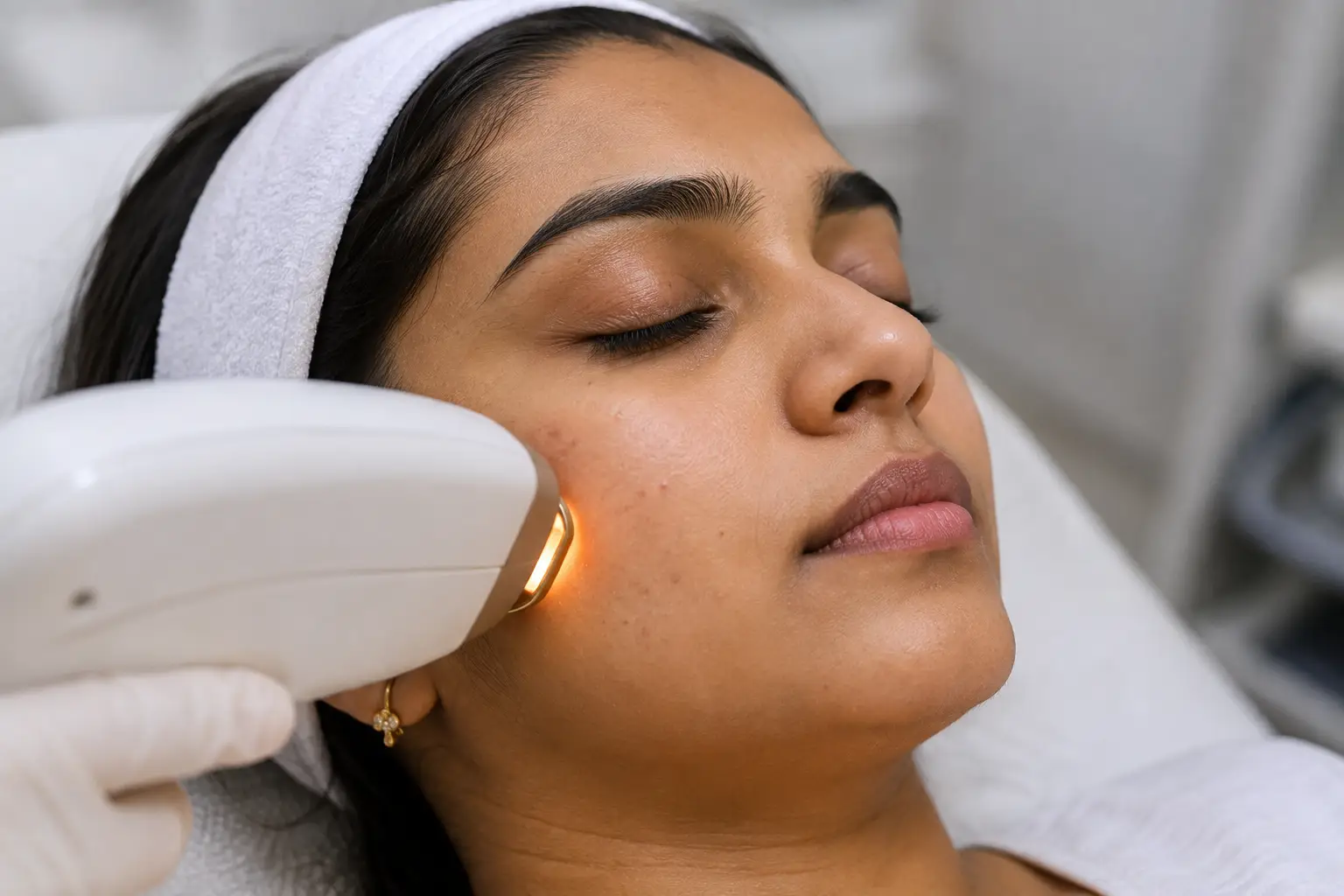
Yes, laser and light-based therapies can reduce facial hirsutism in women with PCOS.
The 2023 International Evidence-Based PCOS Guideline recommends considering laser and light therapies for reducing facial hirsutism and recognises potential benefits for quality of life and psychological well-being.
However, there is an important qualification:
Women with PCOS may require more laser sessions than women whose excess hair is not hormonally driven.
The same guideline specifically states that a greater number of treatments may be needed in PCOS compared with idiopathic hirsutism.
That is one of the most important expectations to understand before starting treatment.
Why Do We Say “Laser Hair Reduction” Rather Than Guaranteed Permanent Removal?
Marketing often uses the phrase permanent laser hair removal.
Clinically, long-term hair reduction is the safer expectation.
Laser can substantially reduce the number, thickness and speed of growth of suitable hairs.
But hormonal conditions such as PCOS can continue stimulating previously inactive or finer follicles.
So a woman may achieve a major reduction and still develop some new hair later.
Morph Aesthetic’s own PCOS guidance acknowledges this point, stating that women with PCOS may require more sessions and sometimes maintenance treatment because the underlying growth is hormonally driven.
So the realistic goal is:
much less unwanted hair + slower regrowth + finer remaining hair + easier maintenance
rather than promising that not one facial hair will ever appear again.
How Does Laser Hair Reduction Work?
Laser hair reduction directs light energy toward pigment within the hair.
The absorbed energy damages the targeted follicular structures enough to reduce future hair production.
Dark, coarse hair generally provides a better target than very fine, light or non-pigmented hair.
The Endocrine Society recommends photoepilation particularly for unwanted brown or black hair and notes that laser type should be selected carefully for darker skin tones.
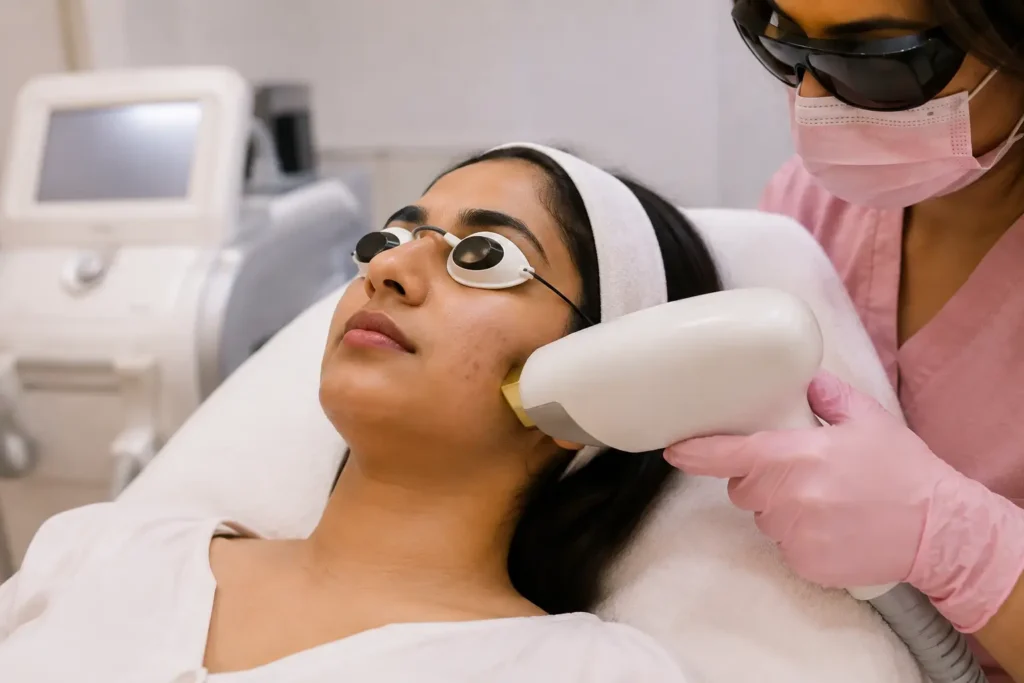
Morph Aesthetic currently uses diode laser technology with integrated cooling for laser hair reduction at its Ahmedabad clinic.
Why Does Laser Require Multiple Sessions?
Hair does not all grow at the same time.
Individual follicles move through different phases of the hair-growth cycle.
Laser works best when suitable hairs are in an active growth phase, so one treatment cannot effectively target every follicle at once.
That is why sessions are spaced across time.
For ordinary laser hair reduction, Morph states that many patients require a series of sessions based on the treatment area and hair characteristics.
With PCOS, the number may be greater because hormonal activity can continue influencing hair growth. The international guideline specifically warns that PCOS patients may need more sessions than women with idiopathic hirsutism.
There is therefore no honest universal statement like:
“Exactly six sessions will permanently remove PCOS hair.”
That would be misleading.
Why Can PCOS Hair Return Even After a Good Laser Result?
Suppose laser successfully reduces many coarse hairs around the chin.
The treated follicles may respond well.
But PCOS is not a condition confined to those individual hairs.
If androgen activity remains significant, other susceptible follicles can become more active over time.
That means the woman may later notice:
- A few new coarse hairs
- Gradual regrowth in hormonally sensitive areas
- Increased hair during hormonal changes
- Need for occasional maintenance treatments
This does not automatically mean the laser failed.
It may mean the underlying hormonal tendency remains.
That is why treating PCOS-related hirsutism can involve both:
controlling the hormonal driver where medically appropriate
and
reducing existing unwanted hair directly.
The Endocrine Society recommends considering pharmacological treatment to minimise regrowth in women with known hyperandrogenism who undergo hair-removal therapy.
Should You Treat the PCOS Before Starting Laser?
It does not always have to be an either-or decision.
A woman may receive appropriate medical management for PCOS while also using laser to reduce existing hair.
The treatments address different aspects of the problem.
PCOS management
May help address the underlying hormonal and metabolic condition.
Laser hair reduction
Targets existing unwanted pigmented hair follicles.
The 2023 international guideline includes both medical/lifestyle management and laser therapy among approaches that can address PCOS features.
If PCOS is not currently being medically managed, discussing it with an appropriate gynecologist or endocrinologist can make sense rather than expecting the aesthetic treatment alone to manage the entire condition.
Can Hormonal Medicines Reduce Facial Hair?
For selected women, medical treatment can help reduce androgen-driven hair growth.
The exact choice depends on medical history, pregnancy plans, menstrual symptoms, contraindications and the nature of the hormonal problem.
The Endocrine Society recommends combined hormonal contraceptives as one common first-line pharmacological approach for appropriate premenopausal women with clinically significant hirsutism who are not seeking pregnancy, with antiandrogen therapy considered in selected cases when response remains inadequate.
These are prescription treatments.
They should not be self-started from online advice.
Some antiandrogen medicines can pose pregnancy-related risks and require appropriate contraception and medical supervision.
Morph’s role in this blog should remain focused on laser hair reduction rather than pretending an aesthetic clinic visit replaces full PCOS medical management.
Is Laser Safe for Indian Skin?
Laser hair reduction can be performed on darker skin tones, but device selection, settings, cooling and operator experience matter.
The Endocrine Society specifically recommends longer-wavelength, long-pulse technologies such as diode or Nd:YAG systems with appropriate cooling for women with darker skin who choose photoepilation.
Morph Aesthetic states that its Ahmedabad clinic uses diode laser technology with cooling and that treatment parameters are customised after assessing the patient’s skin and hair type.
The correct laser setting is not simply:
“Maximum power = maximum result.”
Too aggressive a setting can increase the risk of burns or pigmentation problems, while an unsuitable low-energy approach may produce poor results.
The treatment needs to balance efficacy and skin safety.
Can Laser Cause More Hair Growth?
Rarely, a phenomenon called paradoxical hypertrichosis can occur, where hair growth increases rather than decreases around treated areas.
This has been reported particularly with facial laser treatment in some skin types and populations.
The Endocrine Society specifically warns that paradoxical hypertrichosis is a recognised potential complication of photoepilation and recommends careful laser selection for women with darker skin tones.
This is one reason it is a bad idea to treat very fine facial “peach fuzz” indiscriminately with laser.
Laser works best when there is an appropriate hair target.
A proper consultation should assess:
- Hair thickness
- Hair colour
- Skin tone
- Treatment area
- Hormonal history
before deciding whether laser is suitable.
Is Every Type of Facial Hair Suitable for Laser?
No.
Laser depends on pigment within the hair.
So it tends to work better on coarse, dark hairs than on:
- White hair
- Grey hair
- Very blonde hair
- Some very fine facial hairs
The Endocrine Society recommends electrolysis rather than photoepilation for white or blonde unwanted hair because these hairs contain insufficient pigment for laser targeting.
This matters particularly on the face.
If someone has only very fine facial fuzz, automatically recommending laser simply because the machine is available is not good practice.
Laser vs Electrolysis for PCOS Facial Hair
Both methods can have a role, but they work differently.
Laser Hair Reduction
Best suited to larger numbers of appropriately pigmented hairs.
It can treat multiple follicles during each session and is therefore useful for areas such as the chin, jawline or sideburn region when the hair is coarse and dark.
Electrolysis
Targets individual follicles.
It may be useful for hair colours that respond poorly to laser or for small numbers of persistent hairs.
Endocrine Society guidance broadly recommends photoepilation for brown or black unwanted hair and electrolysis for white or blonde hair.
The right choice depends on the actual hair rather than simply whether someone has PCOS.
Waxing vs Laser for PCOS Hair
Waxing removes existing hairs from the root.
It can give a temporarily smooth result but does not reduce the hormonal stimulus that causes future growth.
Laser aims to progressively reduce the ability of suitable follicles to produce coarse hairs.
So for someone waxing the chin every one or two weeks for years, laser may reduce the ongoing maintenance burden.
However, because PCOS can activate additional follicles over time, maintenance treatment may still be needed.
Should You Wax Between Laser Sessions?
Usually, methods that remove the hair from the follicle, such as waxing or tweezing, are avoided during a laser treatment course because the laser needs a pigmented hair target within the follicle.
Shaving is often preferred between sessions because it cuts the surface hair without pulling the target out of the follicle.
Exact pre-treatment instructions should follow the clinic’s protocol and the laser being used.
Can Laser Help With Chin Hair and Upper-Lip Hair?
Yes, when the hair is appropriate for laser.
Common female facial treatment areas include:
- Upper lip
- Chin
- Jawline
- Sideburns
- Lower face
Morph lists the face among the areas treated with laser hair reduction at its Ahmedabad clinic and individualises treatment based on skin and hair characteristics.
However, the upper lip and chin can behave differently because hormonal influence is not identical across every area.
PCOS-related chin and jaw hair may therefore require a longer-term treatment strategy.
Will Laser Improve Ingrown Hair?
Reducing coarse hair can also reduce the repeated cycle of shaving, waxing and plucking that may contribute to ingrown hairs and irritation in some people.
But laser should not be presented as a cure for every skin bump or pigmentation problem.
If significant acne, folliculitis or pigmentation is present, the skin itself may need separate treatment.
What Results Should Someone With PCOS Realistically Expect?
A good result should be described realistically rather than with a guarantee.
Over a treatment course, suitable patients may notice:
- Reduced number of coarse hairs
- Slower regrowth
- Finer remaining hair
- Longer periods between hair-removal sessions
- Less need for waxing or threading
Women with PCOS may require additional treatments or maintenance compared with women whose unwanted hair is not hormonally driven.
The goal should be meaningful hair reduction, not an impossible promise of zero future hormonal hair.
How Many Laser Sessions Does PCOS Facial Hair Need?
There is no fixed number that is correct for every woman.
Treatment requirements depend on:
- Hormonal activity
- Hair density
- Hair thickness
- Hair colour
- Skin type
- Treatment area
- Laser technology
- Previous hair-removal methods
- Individual response
Morph states that many general laser patients undergo a series of sessions and specifically notes that PCOS-related hair may need additional sessions and maintenance.
The 2023 PCOS guideline supports this, stating that women with PCOS may require a greater number of laser treatments to achieve hair reduction.
So don’t choose a clinic simply because someone promises:
“Only four sessions needed.”
The biology does not work on a universal package schedule.
Will Maintenance Sessions Be Needed?
Possibly.
Maintenance does not necessarily mean the initial treatment failed.
If hormonal activity stimulates new follicles later, occasional additional sessions can help manage the new growth.
Morph itself advises that PCOS patients may require maintenance because laser reduces hair but cannot completely switch off the hormonal driver.
A woman whose PCOS is well-controlled may have a different long-term pattern from someone with ongoing significant hyperandrogenism.
What Should You Do Before Starting Laser for PCOS Facial Hair?
1. Make sure the facial hair pattern is understood
If you already have a confirmed PCOS diagnosis, tell the treating clinician.
If you have significant new facial hair but have never been evaluated for PCOS or another hormonal condition, consider medical assessment.
2. Tell the clinic about medications
Some medicines can affect the skin or treatment plan.
3. Avoid unnecessary tanning or heavy sun exposure
Laser parameters need to account for skin pigmentation.
4. Stop waxing or tweezing according to treatment instructions
The target hair needs to remain in the follicle.
5. Set realistic expectations
PCOS may mean a longer treatment course and possible future maintenance.
What Happens During Laser Hair Reduction?
At Morph Aesthetic, the process begins with assessment of the skin type, hair type and treatment area before selecting treatment parameters. The clinic states that it currently uses diode laser technology with integrated cooling.
During treatment, laser energy is delivered to the selected area.
Some people describe the sensation as warmth or a brief snapping feeling, while cooling can reduce discomfort.
Afterward, temporary redness or sensitivity can occur.
The exact experience varies according to:
- Treatment area
- Hair density
- Laser settings
- Skin sensitivity
Patients should follow the clinic’s aftercare instructions rather than applying strong active skincare immediately afterward without guidance.
What Should You Avoid After Facial Laser?
Post-treatment advice varies, but protecting the recently treated skin is important.
Patients are commonly advised to follow recommended sun protection and avoid irritating the area immediately after treatment.
If redness, blistering, significant pain or unusual pigmentation develops, contact the treating clinic rather than trying random home remedies.
Laser treatment should have appropriate professional oversight, particularly for facial treatment and darker skin tones. The 2023 PCOS guideline specifically encourages women to seek laser hair-reduction therapy from suitably qualified and experienced providers.
When Laser Alone Is Not Enough
This is the central point of this blog.
Imagine someone has severe ongoing PCOS-related androgen activity.
She completes a laser course.
The existing coarse hair becomes substantially reduced.
But the hormonal issue remains completely untreated.
Over time, new follicles may become stimulated.
The response should not necessarily be:
“Laser doesn’t work.”
The more complete strategy may involve:
medical management of PCOS + laser reduction of unwanted hair + maintenance when necessary.
The Endocrine Society specifically suggests pharmacological management alongside direct hair removal for women with known hyperandrogenism when appropriate, because it can help minimise regrowth.
When Should You Seek Medical Evaluation Before Laser?
Consider medical evaluation particularly if facial hair is:
- Suddenly increasing rapidly
- Becoming unusually severe
- Accompanied by major menstrual changes
- Associated with significant scalp hair loss
- Accompanied by other new signs of androgen excess
- Developing without an established explanation
The international PCOS guideline advises further investigation when severe or worsening hyperandrogenism appears suddenly because conditions other than ordinary PCOS may occasionally be responsible.
Laser should not be used to hide a symptom that actually needs diagnosis.
Laser Hair Removal for PCOS in Ahmedabad at Morph Aesthetic
Morph Aesthetic provides laser hair reduction in Sola, Ahmedabad, including treatment of facial areas. The clinic currently uses diode laser technology with cooling and tailors the treatment plan according to skin and hair characteristics.
Morph is located near S.G. Highway in Sola, Ahmedabad.
For women with PCOS, the consultation should focus not only on the area being treated but also on:
- Whether the hair is suitable for laser
- Hair thickness and density
- Skin type
- Hormonal history
- Expected number of sessions
- Possibility of maintenance
- Realistic long-term reduction
That is far more useful than promising “permanent hair removal” without acknowledging the hormonal component.
PCOS Facial Hair Does Not Have to Mean Endless Waxing
PCOS-related facial hair can be frustrating because traditional hair-removal methods need to be repeated again and again.
Laser offers a different approach.
It targets appropriate hair follicles directly and can produce meaningful long-term reduction.
But PCOS changes the expectations.
The realistic pathway is:
Identify whether the hair is hormonally driven
→ manage PCOS medically when appropriate
→ use laser for suitable dark, coarse hair
→ complete enough sessions for the growth cycle
→ review the response
→ use maintenance when required
Laser can reduce the visible problem.
It does not cure PCOS itself.
Understanding that difference before beginning treatment makes it much easier to judge whether the result is genuinely successful.
For women looking for laser hair removal for PCOS in Ahmedabad, Morph Aesthetic offers facial and body laser hair-reduction treatment with individual assessment at its Sola clinic.
FAQs
EXCELLENTTrustindex verifies that the original source of the review is Google. Good experiencePosted on GoogleTrustindex verifies that the original source of the review is Google. It is a very good clinic with a very helpful staff and extremely clean. It gives u a personalized experience and comfort like never before❣️Posted on GoogleTrustindex verifies that the original source of the review is Google. good behaviour and nice counsaltuntPosted on GoogleTrustindex verifies that the original source of the review is Google. Had a great experience with dr Ronak and dr dhaval for surgery , sakshi ma’am and dr shruti also served us meticulously.Posted on GoogleTrustindex verifies that the original source of the review is Google. Excellent service and amazing result. Highly recommend morph anesthetic. Professional staff.great care.and a wonderful experience. Best plastic surgeon in Ahmedabad.Posted on GoogleTrustindex verifies that the original source of the review is Google. Very nice service..Posted on GoogleTrustindex verifies that the original source of the review is Google. I recently had my child's surgery done at Morph Aesthetic Clinic by Dr. Dhaval Vanzara and Dr. Ronak Kadia, and I couldn't be happier. Both doctors are exceptionally skilled and professional. Before the procedure, they explained everything to me so clearly, and the final result is exactly what I expected and hoped for. Beyond their expertise, both doctors have a wonderful, kind, and supportive nature. Highly recommend this clinic for their outstanding care and perfect results.Posted on GoogleTrustindex verifies that the original source of the review is Google. Nice and clean work and dr is so humble and passionate for work and so good for attend the patient